

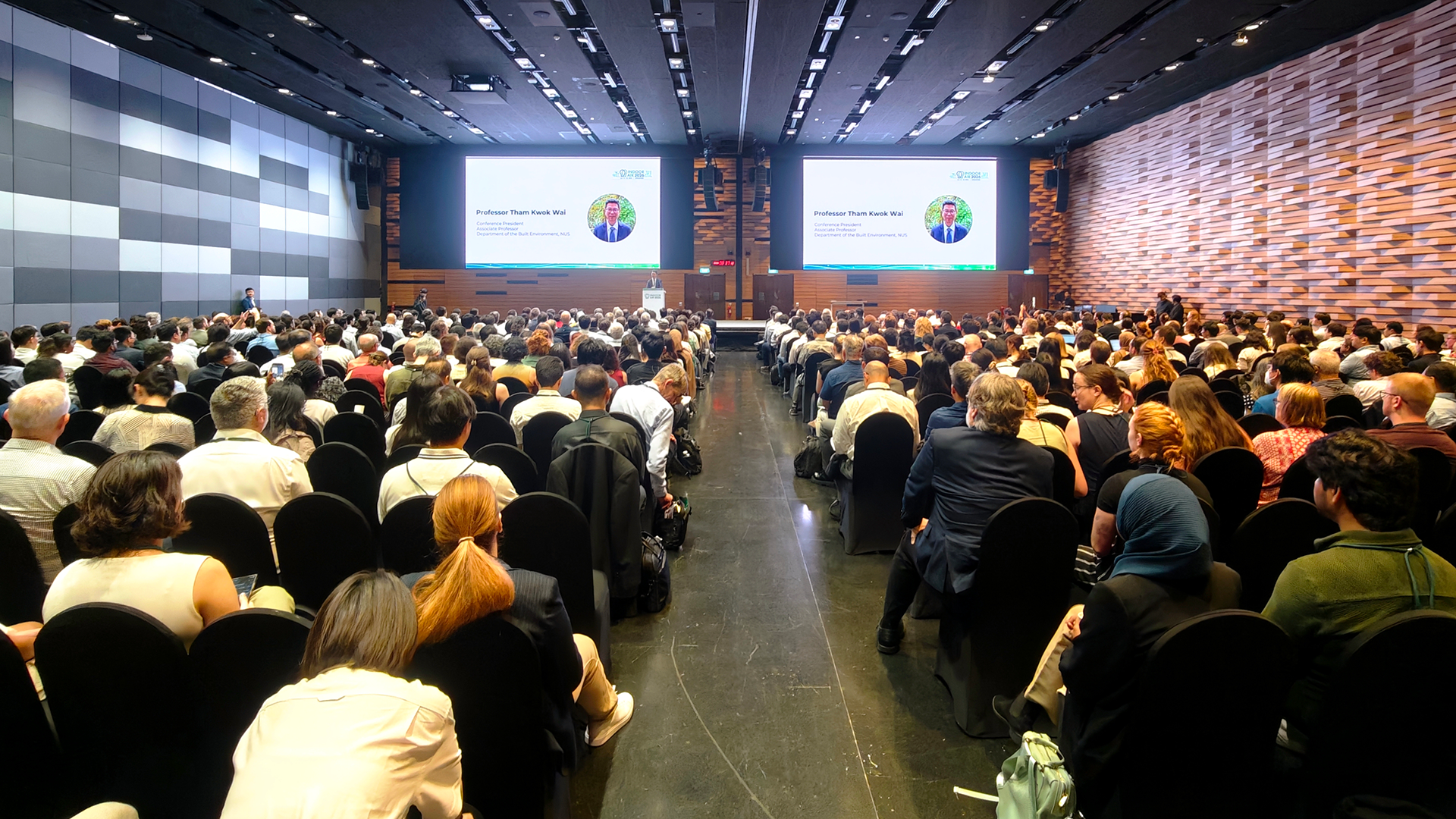
Indoor Air 2026, the world’s leading conference on indoor air quality, has opened in Singapore, bringing together more than 900 experts to discuss how buildings can better support health, wellbeing and resilience in a changing climate.
Co-organised by CDE’s Department of the Built Environment and the Singapore Green Building Council, the four-day conference running from 15 -18 June 2026 brings together academics, engineers, medical practitioners, policymakers and industry experts from around the world and is convened by the International Society of Indoor Air Quality and Climate.
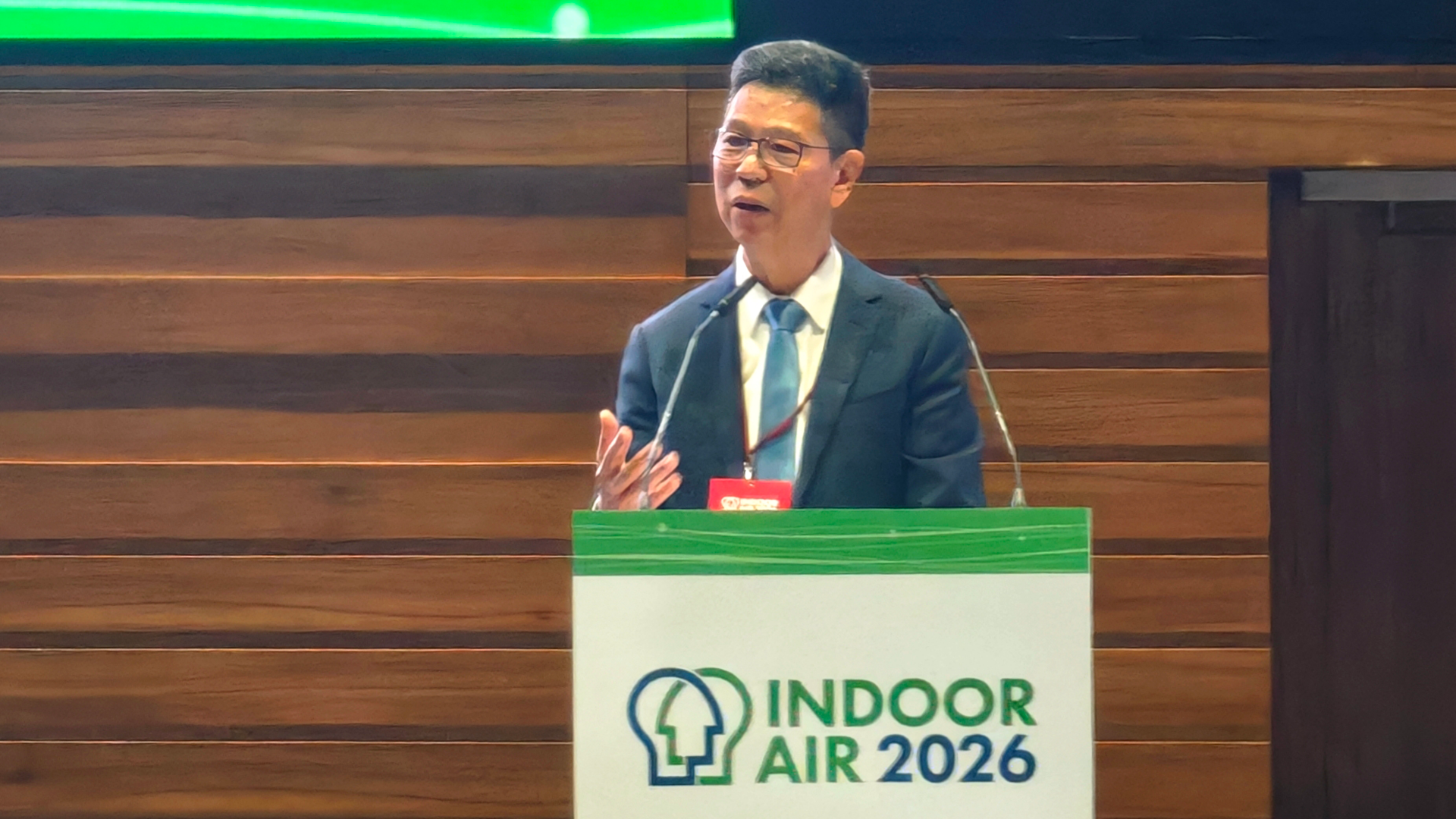
Associate Professor Tham Kwok Wai (Department of the Built Environment) who is serving as Conference President of Indoor Air 2026, said the conference comes at a time when indoor air quality has become central to health, resilience and the way cities are designed.
“Indoor air quality is no longer a niche technical concern; it is a health imperative that affects how we live, work, and learn in dense urban environments,” he said. “The knowledge exchanged here over the next four days will deepen insights, drive innovation, and shape building standards and policies for years to come.”
Under the theme “Enhancing Wellbeing in Existential Challenges: Deepening Understanding, Building Resilience”, the conference focuses on challenges including climate change, pandemics, decarbonisation, urbanisation and the growing need for healthier indoor environments.
The Department of the Built Environment is contributing both as a co-organiser and through the expertise of its researchers in the built environment, ventilation, indoor air quality, infectious disease transmission and public health. More than 1,000 submissions were received for the conference, with over 900 papers to be presented. Singapore researchers contributed more than 50 papers.
Held at Singapore Management University, the conference will include a session on airborne outbreaks in confined and high-occupancy environments, to be held on Thursday, 18 June.
This session will be co-convened by Professor Chandra Sekhar (Department of the Built Environment) an expert in building ventilation and indoor air quality, alongside Dr Julian Tang from University Hospitals of Leicester NHS Trust in the UK.
Recent incidents – including a cruise-ship Hantavirus event that made headlines around the world – have highlighted the vulnerability of confined, high-occupancy spaces to airborne pathogens. With that in mind, the session will examine how engineering controls, such as ventilation optimisation, outdoor-air strategies and airflow management, can help reduce the risk of airborne disease transmission in places such as hospitals, schools, offices, aircraft and other shared environments. It will also discuss how engineers and medical experts can work together to investigate outbreaks and guide practical, cost-effective interventions.
Indoor Air 2026 is supported by partners including the Ministry of Sustainability and the Environment, the Building and Construction Authority, the Centre for Liveable Cities Singapore and the National Environment Agency.
CDE contributions at Indoor Air 2026
Papers Presented by CDE Faculty
Assessment and Mitigation of Human Exposure to Airborne Particles of Outdoor Origin in Residential Homes
Professor Rajasekhar Balasubramanian
Simple DIY Strategies for Creating Isolation and Protected Rooms in Residential Dwellings in the Tropics
Professor Chandra Sekhar
Extreme Heat and Wind-Driven Rain Impact on Data Center Cooling Systems: A CFDBased Resilience Assessment
Associate Professor Poh Hee Joo
A Control Algorithm for an Adaptable Cooling Coil VAV System under Broad Load Diversity
Associate Professor Tham Kwok Wai
Papers presented by postdoctoral fellows, PhD students and CSC (sponsored by China Scholarship Council) students
Towards an understanding of the sleep health of working adults in an urbanized and tropical environment using the PSQI analysis framework
Tan, Le En (PhD student)
Field measurements of Tropical Bedroom Environmental Quality and Sleep (TBEQS)
Tan, Le En (PhD student)
Thermal alliesthesia under elevated air temperature with personally controlled fan operations
Yang, Fan (Claire/NUS) (student)
Experimental Performance Evaluation of a Novel Directional Fan in Dynamic Environments
Du, Heng (postdoctoral fellow)
Systematic Evaluation of Radiative Cooling Performance during the Day and Night in Hot and Humid Regions
Loh, Kelly (PhD student)
Impacts of Heatwaves on Indoor Thermal Environments under Residential Air Conditioning Operation
Dai, Longkang (CSC visiting student)
When Cooling Gets Personal: Smart Directional Fans Enabled by UWB and Infrared Localization with Digital-Twin Logic for Energy-Efficient Cooling
Shah, Iqbal (PhD student)
Performance evaluation of Smart Directional Ceiling Fans in Hybrid Cooling: CFD Study of a Singapore Shared Meeting Room
Li, Sishi (postdoctoral fellow)
Multimodal Analysis of Lighting Layout Factors and Human Responses in Enclosed Work Environments: Toward Human-Centered Design
Wang, Yao (CSC visiting student)
The impacts of climate and seaons on preferred sleep temperature setpoints using largescale data from smart thermostat
Lei, Chenxi (PhD student)
Adaptive Modeling of Occupant Preferred Temperature Setpoints Leveraging Pre-trained Comfort Archetypes
Chen, Kai (postdoctoral fellow)
Systematic evaluation of office comfort temperatures across seasons and climate zones in China and the United States
Xu, Xinbo (postdoctoral fellow)
A Hybrid Physiological–Psychological Framework for Thermal Comfort Prediction under Transient Conditions
Gao, Huanxiang (PhD student)
Validation of RANS and LES Against Wind Tunnel Measurements for Urban Street Canyon Aerodynamics
Lin, Subin (PhD student)
Particulate Air Filtration: Optimising Indoor Air Quality and Energy
Tran, Phuong (postdoctoral fellow)
The Impact of Diffusion on Temperature Stratification in Buoyancy-Driven Displacement Natural Ventilation
Xiang, Yeyu (PhD student)
Influence of Window-to-Door Configurations on Fan-Assisted Airflow Distribution in Residential Rooms
Apparavoo, Pavitri (PhD student)
Evaluating Fan Effects on Airflow and Thermal Comfort in Naturally Ventilated Classrooms in Tropical Climates
Cen, Chao (PhD student)