


Lithium-ion batteries dominate the market for large-scale energy storage today. However, the element’s uneven global distribution and rising costs are driving the search for alternatives. Sodium is roughly a thousand times more abundant in the Earth’s crust and can be extracted from seawater, making sodium-ion batteries a compelling option for grid-scale storage where cost and supply security are paramount.
The safety aspect of such batteries has been an obstacle. Most sodium-ion batteries rely on liquid electrolytes that are flammable and prone to leakage, posing risks in large-scale installations. Solid polymer electrolytes could eliminate these hazards, but they conduct sodium ions too slowly and form unstable contact with the sodium metal negative electrode. Over time, needle-like metal growths called dendrites push through the polymer, short-circuiting the battery, leading to thermal runaway.
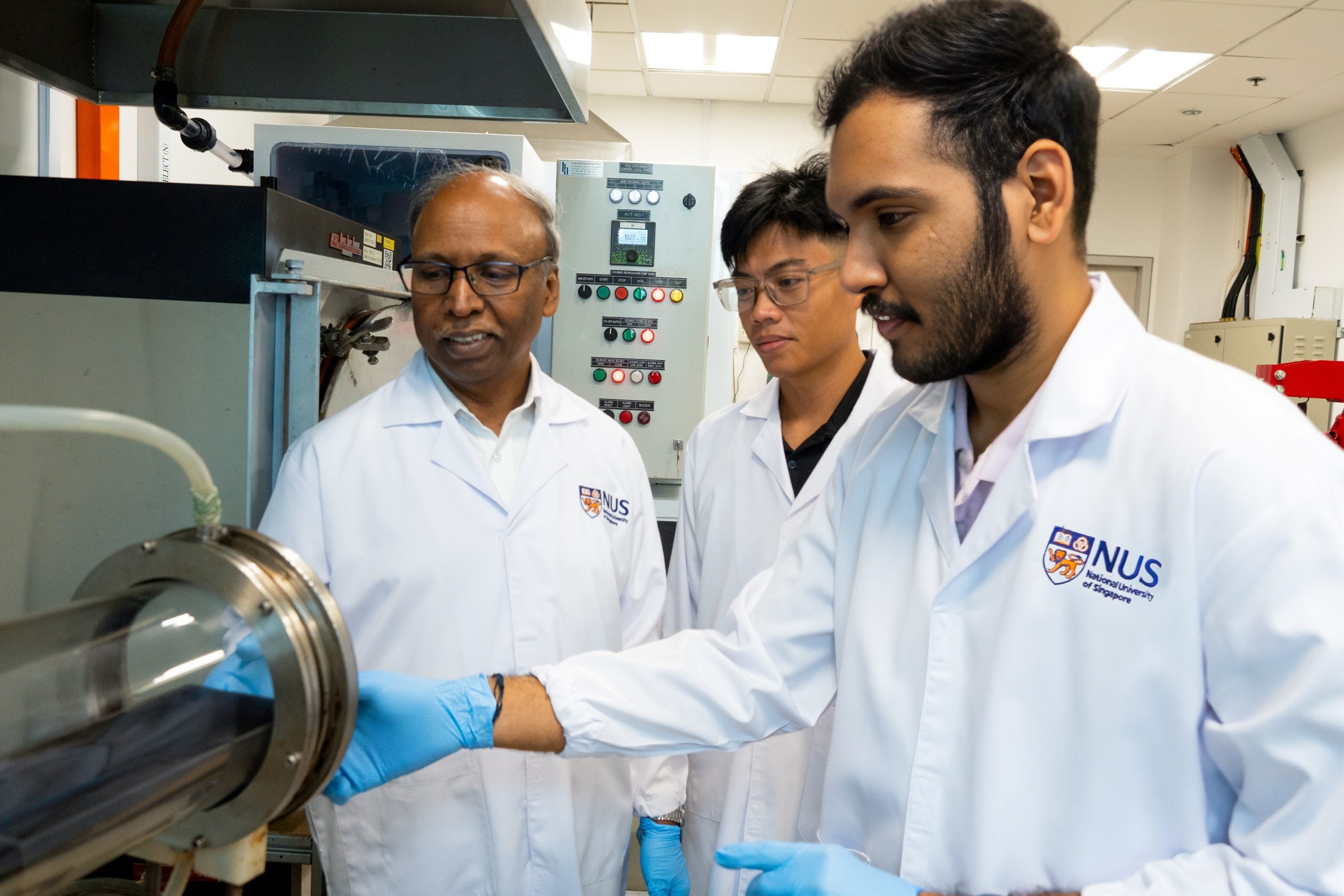
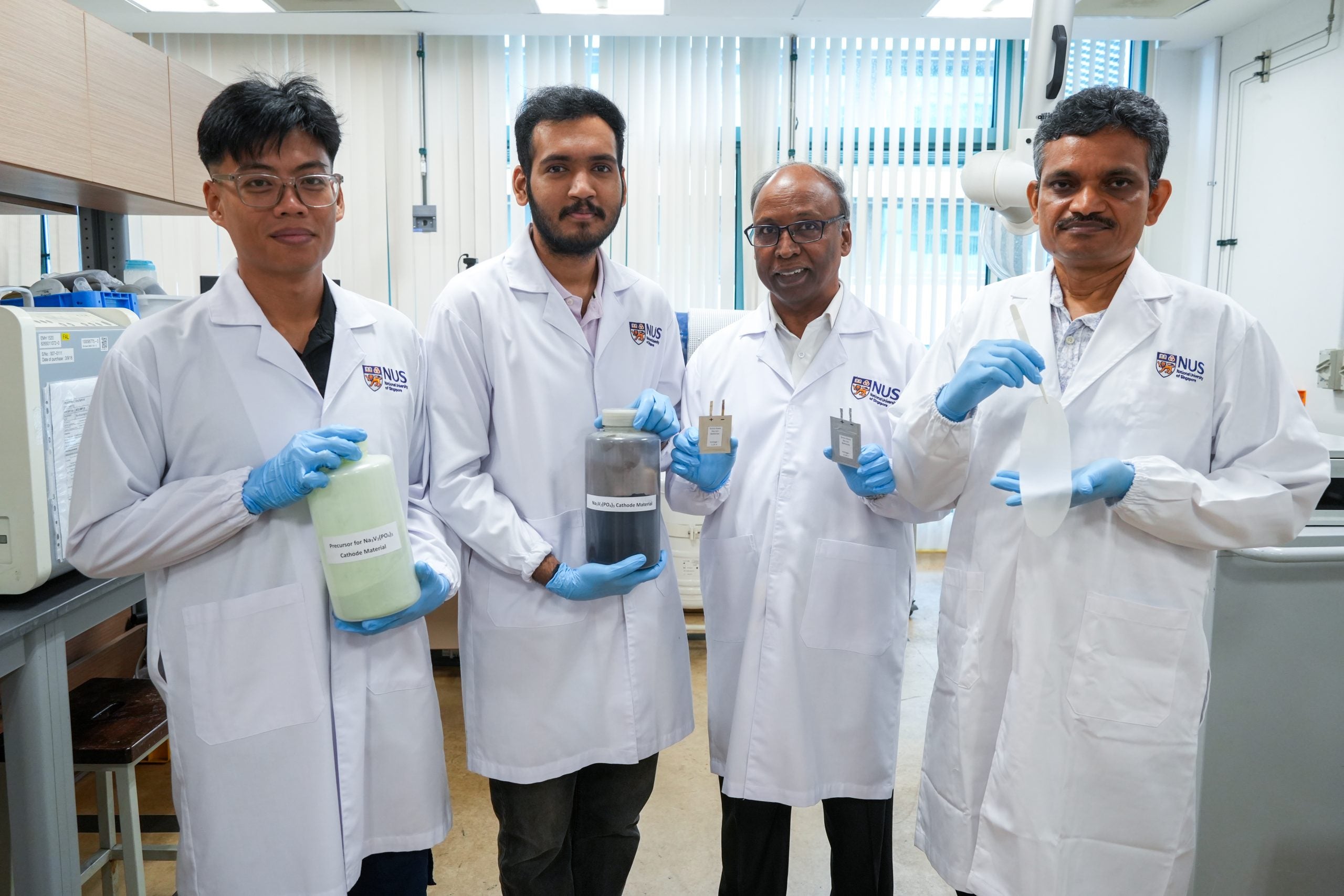
A team led by Associate Professor Palani Balaya from the Department of Mechanical Engineering under the College of Design and Engineering at the National University of Singapore, has now overcome both challenges with a single, low-cost additive. The advance opens a scalable pathway towards safe, affordable all-solid-state sodium batteries for applications ranging from grid-scale energy storage to electric vehicles.
The work was published in Advanced Functional Materials on 6 May 2026.
A simple additive but a structural overhaul
The team used the additive graphitic carbon nitride (GCN), a nitrogen-rich material synthesised by simply heating urea in air at 550 degrees Celsius. The resulting sheets are just two nanometres thick. When incorporated into a polymer electrolyte film made from polyethylene oxide and a sodium salt, they reshape the polymer’s internal architecture in two ways.
The sheet-like, high-surface-area GCN disrupts the polymer’s tendency to form rigid crystalline regions, promoting flexible, disordered zones where sodium ions move more freely. In addition, nitrogen-rich active sites on the GCN surface pull sodium ions away from their salt counterparts, freeing more ions to carry charge. The combined effect more than doubled the electrolyte’s ionic conductivity at 55 degrees Celsius and boosted transference number, the fraction of current carried by sodium ions from 0.19 to 0.51, reducing polarisation and improving battery efficiency.
“What makes our approach powerful is its simplicity,” added Assoc Prof Balaya. “GCN can be made from one of the most widely available chemical precursors in the world and incorporated into a polymer system that is already scalable. That combination of performance and practicality can potentially move the technology towards rapid real-world deployment.”
Blocking dendrites, stabilising surfaces
The GCN additive also transforms the critical interface between the electrolyte and the sodium metal electrode. Repeated charging and discharging causes uneven sodium deposition on the negative electrode surface, which eventually sprouts into dendrites. The team’s GCN-enhanced electrolyte counters this on two fronts. The composite polymer is three times stronger than its unmodified counterpart, giving it the mechanical stiffness to physically block dendrite penetration. The filler also promotes the formation of a protective sodium based inorganic-enriched layer on the electrode surface that guides uniform sodium deposition and suppresses the side reactions that degrade conventional polymer electrolytes.
At a current density of 0.1 mA cm-2, the unmodified polymer electrolyte short-circuited within 250 hours. The GCN incorporated composite electrolyte sustained stable operation for 1,000 hours at the same current density and further demonstrated no failure at a higher current density of 0.2 mA cm-2, exceeding 2,000 hours.
Putting the technology to work
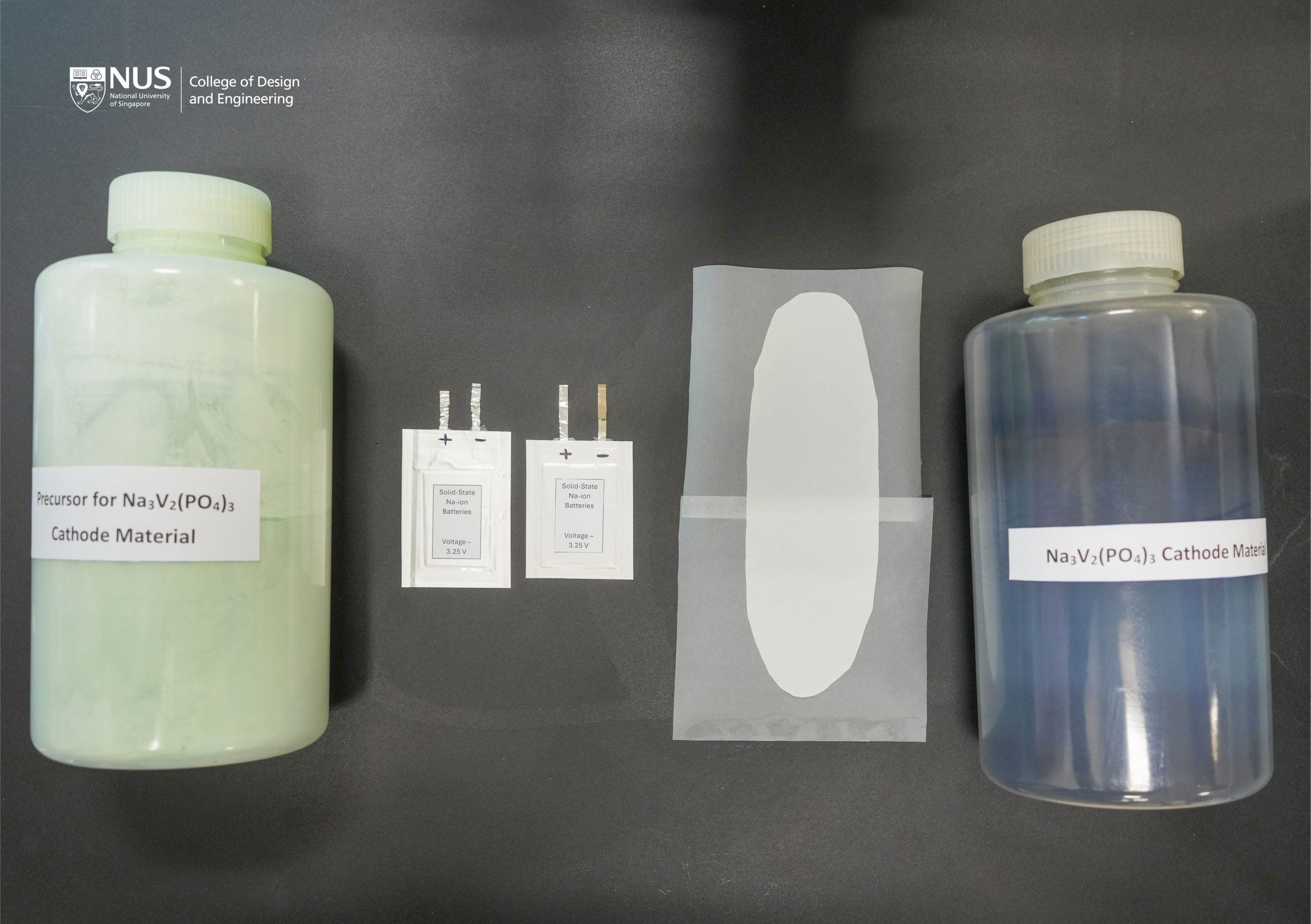
To evaluate the composite electrolyte in a functional battery, the team assembled all-solid-state cells using a carbon coated zinc-doped sodium vanadium phosphate cathode paired with a sodium metal anode. At a charge-discharge rate of 0.5C, the battery retained 95 per cent of its capacity after 500 cycles with a coulombic efficiency of approximately 99.97 per cent. It also handled rates up to 2C and recovered 99 per cent capacity when returned to a slower rate. Battery charge-discharge speed is measured in “C-rates,” where a higher number means faster charging: 1C fully charges the battery in one hour, while 2C does it in half that time.
To test real-world viability, the researchers built a single-layer pouch cell that powered a light-emitting diode through folding, unfolding and even cutting of the cell. Continuous illumination with no short-circuit events confirmed the safety profile needed for commercial deployment.
Building on a decade of sodium battery innovation
This all-solid-state system is the latest in a sustained and expanding programme of sodium-ion battery research at NUS CDE.
Since 2010, NUS CDE researchers have tackled major components of the battery stack. Early work produced a polyanion cathode that demonstrated 30,000 cycles at ultrafast charge-discharge rates, completing each cycle in just 90 seconds. That material was scaled to three-kilogram production batches and validated in commercial-format 18650 cells over 1,000 cycles. Parallel efforts yielded a non-flammable liquid electrolyte that withstands direct flame contact for 60 seconds and remains stable up to 270 degrees Celsius, fire retarding electrolyte along with moisture-stable layered oxide cathode that address one of the toughest manufacturing challenges facing the sodium battery industry.
Current & Future Focus
Building on the latest breakthrough, the team is now optimising solid-state sodium-ion cells for near-ambient operation, targeting a stable performance threshold of 45 degrees Celsius. By utilising advanced hybrid ceramic-polymer electrolytes and novel formulation that act as both structural frameworks and active transport media, the group aims to eliminate the need for intensive thermal management. This transition toward lower-temperature functionality is essential for creating energy-efficient, commercially practical storage solutions that thrive in real-world environments.
In parallel, the researchers are developing bipolar all-solid-state architecture - a stacked design that significantly boosts energy density by minimising redundant packaging and system weight.
To accelerate the journey from lab to market, the group is actively engaging with industry partners for prototype demonstrations, manufacturing scale-up, and potential commercial spin-offs. This collaborative approach ensures the technology is not only scientifically sound but ready for global industrial integration.