


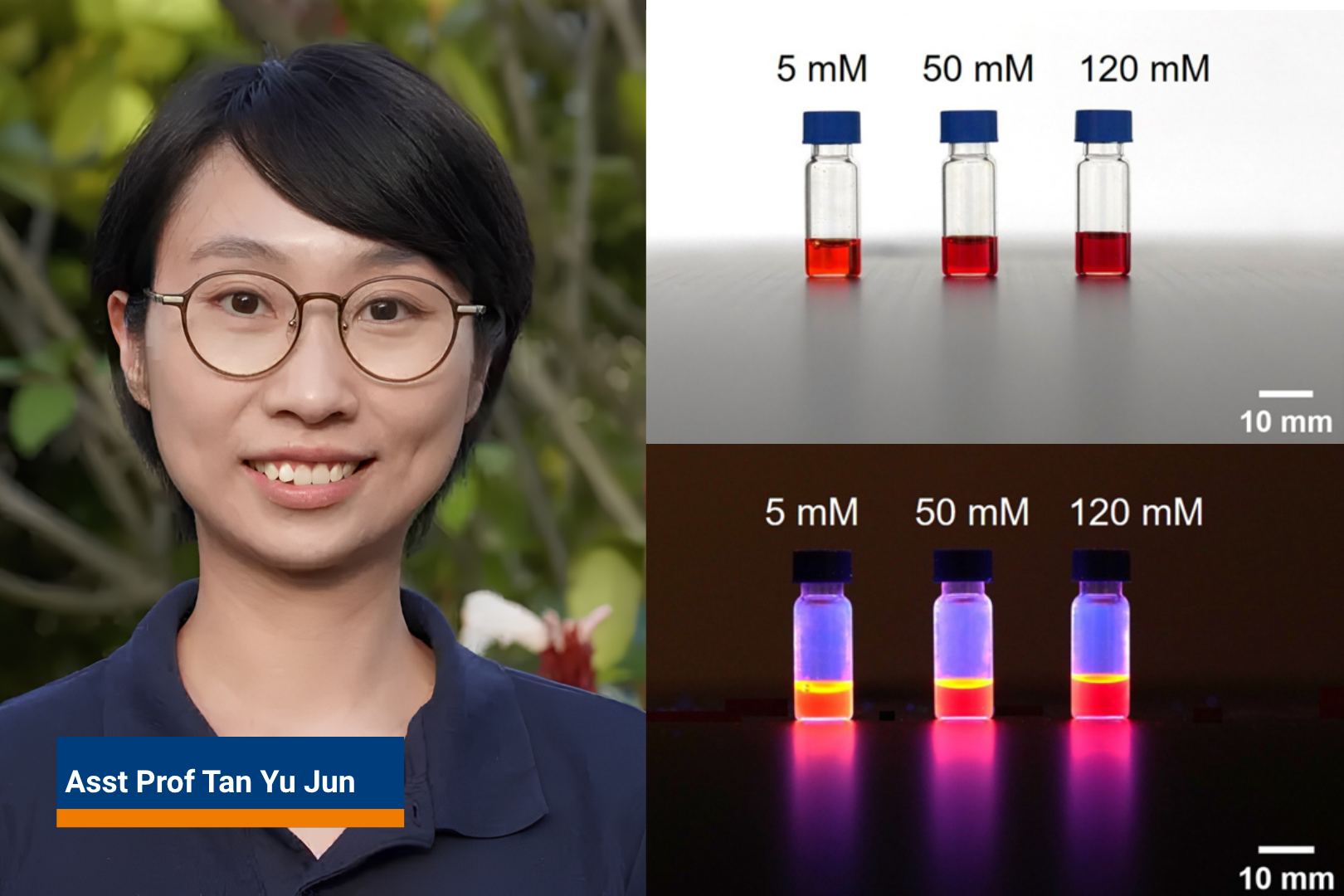
From a skin patch that changes colour to flag abnormal blood sugar, to a diver’s sleeve display that stays readable underwater, the need for bright, flexible screens is growing, but no existing technology delivers the combination of simplicity, low power and robustness these applications need. Existing organic light-emitting diodes require complex multilayer structures that are difficult to bend reliably. Light-emitting capacitors are simpler, but they demand hundreds or even thousands of volts, ruling out anything worn on the body.
Electrochemiluminescent (ECL) devices offer a more viable solution. They generate light through electrically triggered chemical reactions inside a liquid layer sandwiched between two electrodes, and are inherently thin, flexible and energy efficient. Their persistent shortcoming, however, has been dimness: too faint for a user to easily read, and too unstable for anything beyond a brief lab demonstration.
A team led by Assistant Professor Tan Yu Jun from the Department of Mechanical Engineering at the College of Design and Engineering, National University of Singapore (NUS CDE), working in partnership with researchers in the Institute of Materials Research and Engineering (IMRE) and the Institute of High Performance Computing (IHPC), under the Agency for Science, Technology and Research, has now overcome that barrier.
By changing the liquid inside the device and redesigning its electrode arrangement, the researchers cranked ECL brightness up to 1,552 candelas per square metre — about three to four times the brightness of a typical smartphone screen used indoors, and 3.2 times brighter than the best conventional ECL devices.
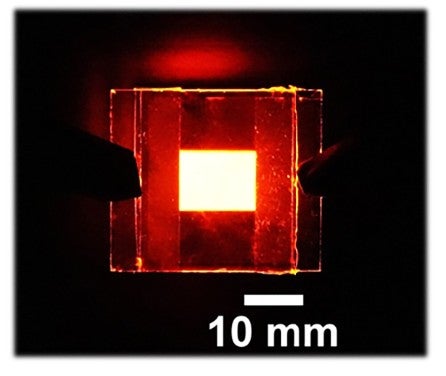

“Our work has also made these devices practical for the first time as they produce a steady, continuous glow rather than the brief flicker of earlier designs, and they can run on a small battery,” added Asst Prof Tan.
The study was published in Science Advances on 20 May 2026.
Switching up material and design
ECL is a synthetic cousin of bioluminescence — the glow that deep-sea squid and fireflies produce — except here, electricity drives the light-emitting chemical reaction. In an ECL device, a light-emitting molecule dissolved in a liquid electrolyte sits between two electrodes, and an alternating current drives the molecule through repeated cycles of gaining and losing electrons that release photons. The process is energy-efficient, but in conventional devices most of the reaction energy is wasted by sluggish charge movement and chemical breakdown at the electrode surface, leaving the glow too faint and too short-lived to be useful.
The team traced the problem to the electrolyte. Conventional ECL devices use a widely adopted ionic liquid (a salt that stays liquid at room temperature) whose large, bulky ions impede charge flow. The researchers switched to an ionic liquid with a smaller, more nimble negative ion and found it performed far better, then unpicked why. The two component ions tackle separate bottlenecks: the smaller negative ion accelerates electron exchange at the electrode and keeps the system chemically stable, while the positive ion dissolves more of the light-emitting dye into the liquid. These combined effects mean faster reactions and more “fuel” for the glow.
The team also redesigned the device itself. Rather than using two identical transparent electrodes, they paired a textured one that boosts the chemical reactions with a smooth one optimised for transparency, and added a thin silver mirror behind the rear electrode to reflect escaping light forward. This combined material-and-architecture strategy delivered the record brightness, along with markedly improved durability. In repeated on-off cycling tests, the new devices maintained brightness up to 82 times higher than the conventional version after 10 cycles, and under continuous operation, they sustained emission for two hours compared with just 29 minutes for the older design.
From a glucose patch to an underwater display
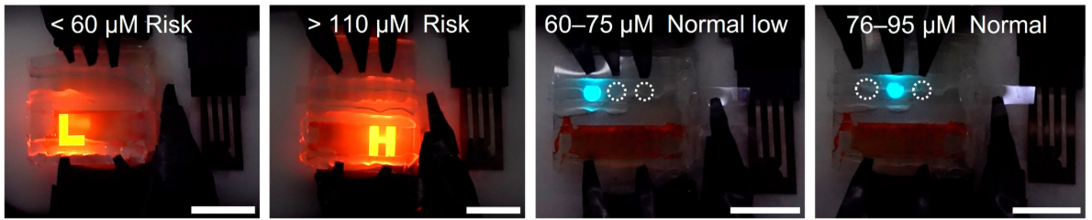
To demonstrate what brighter, stabler ECL enables, the team built three working prototypes. A flexible skin patch used blue and red light to indicate different readings from a sweat glucose sensor. This shows how ECL could provide immediate, easily interpreted feedback from skin-worn health monitors without requiring a separate screen.
In addition, a seven-segment digital panel (the format used in many digital clocks) displayed the numbers “1” to “9” and switched rapidly over repeated cycles. Its ability to produce changing information reliably could support simple displays integrated into smart packaging, environmental sensors and the surfaces of machines or soft robots.
The third prototype was a flexible solid-state device that continued to glow while fully submerged in water. This resistance to water could enable ECL devices to be used for underwater signalling, monitoring and other visual interfaces in wet environments.
More broadly, the team envisions ECL becoming a thin, soft, transparent and low-power visual layer that conforms to the surface beneath it. Such devices could display physiological signals directly on the skin or allow soft robots to communicate information about touch, damage and movement through their bodies.
Lighting the path forward
Although the prototypes can produce multiple colours, red emission remains the strongest. Moving forward, the team’s first priority is an interdisciplinary effort combining materials design and device engineering to improve the brightness and stability of blue, green and other colours. This will involve developing new light-emitting molecules and electrolytes while refining the device architecture, with the aim of creating reliable multicolour ECL displays.
The researchers are also developing stretchable and self-healing devices that remain functional when bent or stretched and recover their light-emitting ability after damage. These properties could make ECL devices more robust and adaptable for use in wearables, soft robotic skins and underwater visual interfaces.
“We want to move ECL from a laboratory light-emitting phenomenon towards a practical platform for soft, flexible visual communication,” added Asst Prof Tan. “Expanding the colour range and developing devices that can withstand and adapt to real-world conditions are the next steps towards realising that goal.”