

When thick haze blanketed Singapore in 1997, Professor Rajasekhar Balasubramanian (Department of Civil and Environmental Engineering) did not have a laboratory full of sophisticated equipment ready to investigate it.
Prof Balasubramanian was then a relatively new academic. He had little funding, no postdoctoral researchers or graduate students, and until then, most of his work had involved controlled experiments in the laboratory.
Nonetheless, he was curious about what was happening in the skies above Singapore.
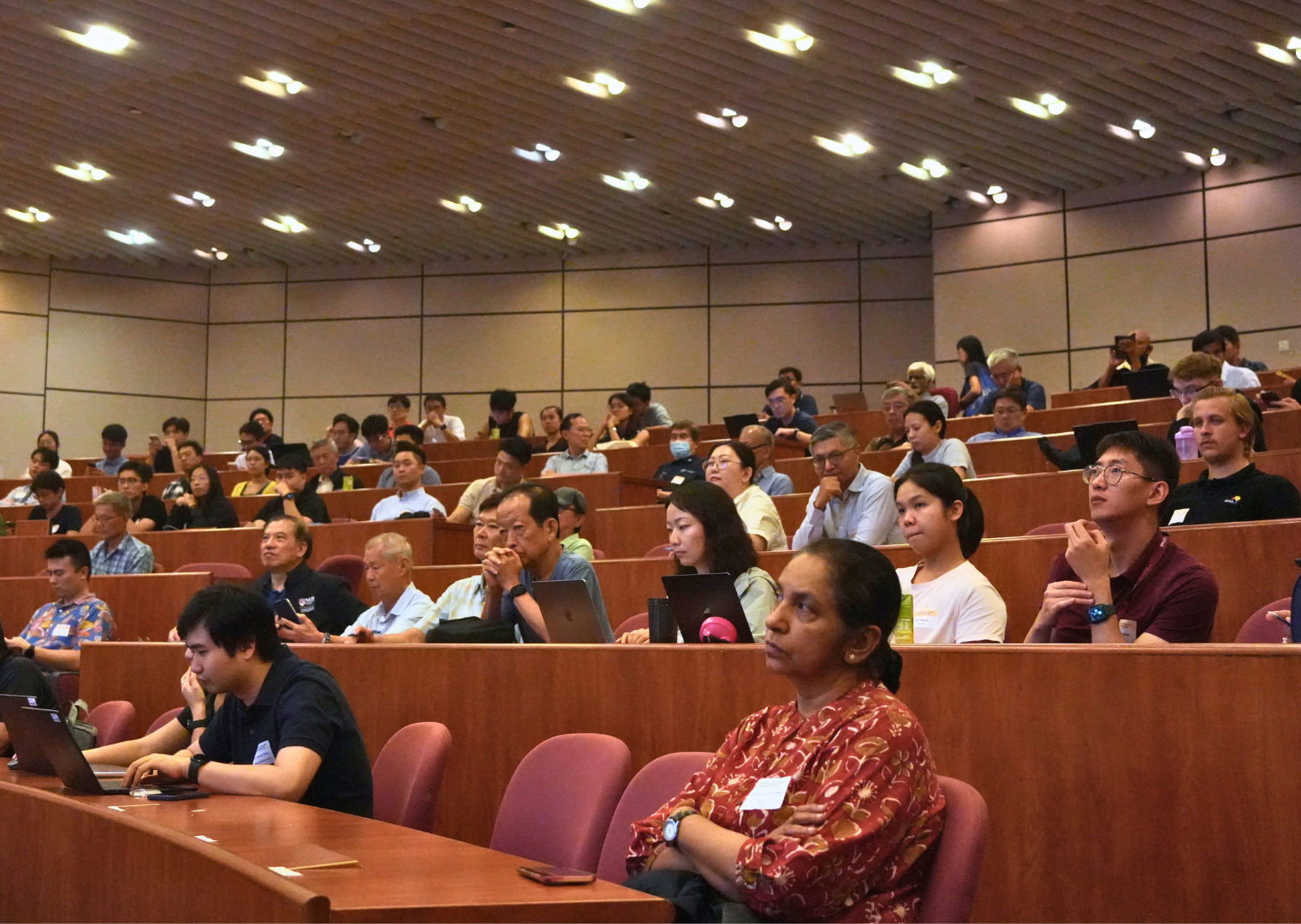
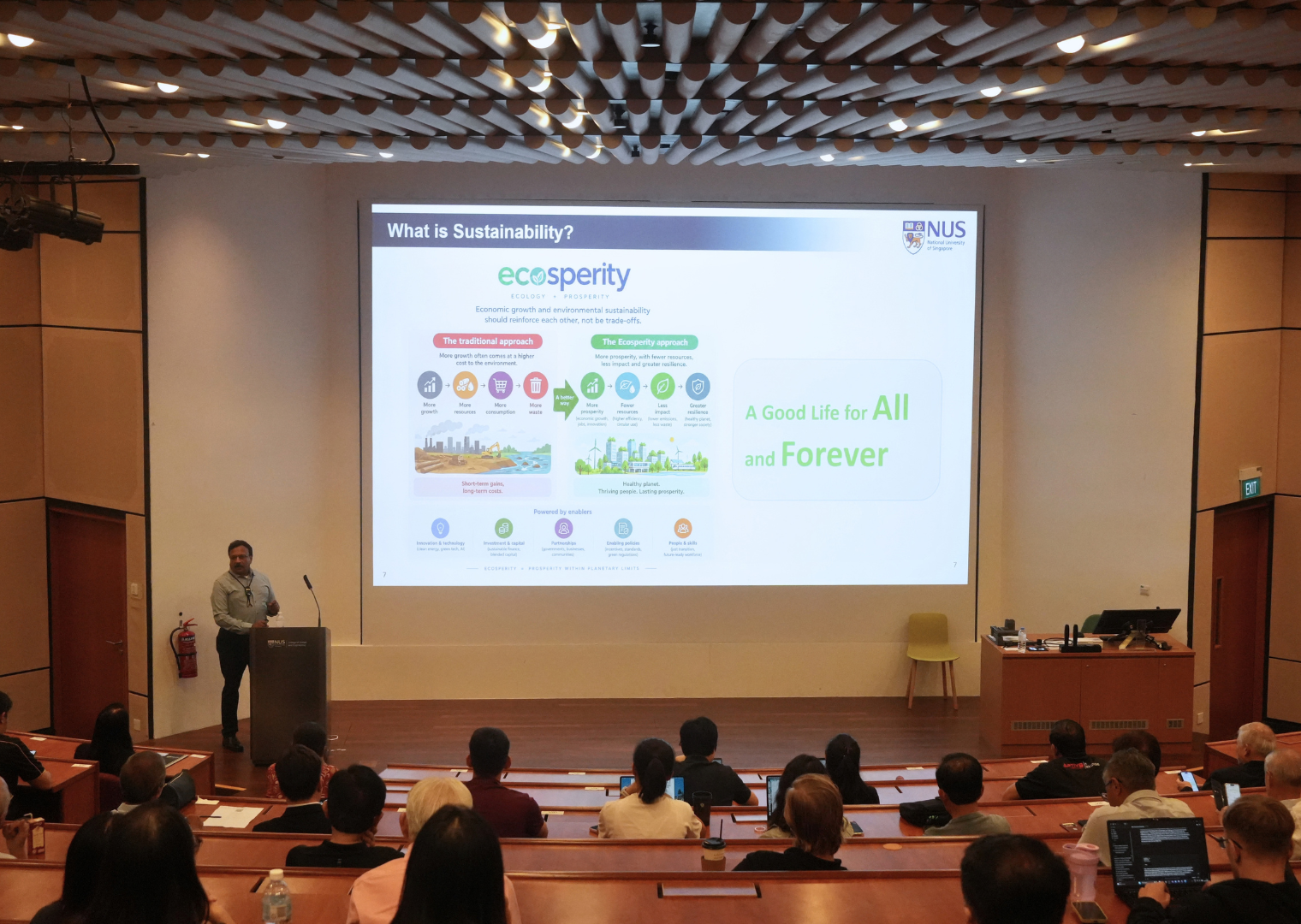
“We should not get intimidated by the challenges we have, but instead we should be excited by the opportunities available for innovation,” he told the inaugural Keppel Sustainable Futures Symposium, held at CDE on 25 September in conjunction with NUS’ flagship sustainability festival, NUS Sustainability CONNECT.
“I looked at the sky. What can I do?” he recalled of that situation.
The answer was to collect rainwater.
His two-year-old daughter helped him gather samples, while he borrowed a pH meter from a neighbour who was a water chemist. Analysing those samples revealed dramatic changes in the chemical composition of rainwater during the haze. He later combined the experimental work with atmospheric modelling to investigate where the pollution reaching Singapore was coming from.
Appointed in 2024 as the inaugural NUS Keppel Professor in Sustainability Solutions, Prof Balasubramanian sees that experience as an early step in a journey from deep expertise in a single area towards working across disciplines to tackle complex, real-world problems.
Drawing on that journey, his lecture made a simple case: sustainability challenges rarely fit neatly within the boundaries of a single academic discipline.
“When it comes to interdisciplinary collaboration, start with the problem, not the discipline,” he said. “If the problem is ill-defined, the solution will also be ill-defined.”
From expertise to collaboration
The experience also began to change the way Prof Balasubramanian thought about his work.
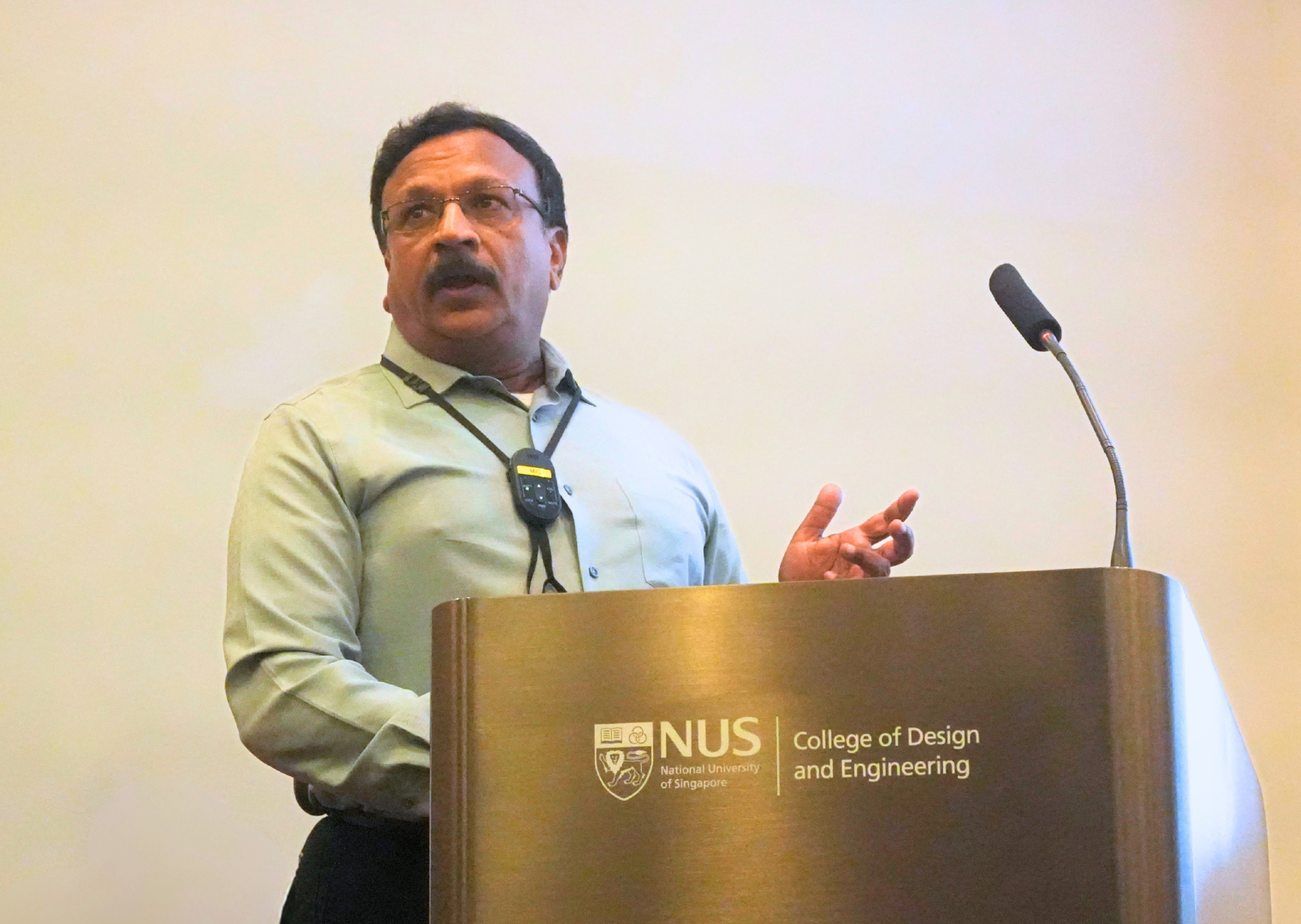
“I realised that I should also broaden my exposure,” he said. “With this integration of deep expertise and cross-disciplinary breadth, we will be able to find innovative solutions to many complex problems through collaboration.”
Over the years, that approach has taken his work in numerous directions.
Research into indoor air quality, for instance, led his team to investigate how people could reduce their exposure to harmful particles during haze events. Working with researchers in mechanical engineering, his team went on to develop nanofibre-coated filters that combined high filtration efficiency with low resistance to airflow.
But the work did not stop with the findings. The team communicated recommendations to the public, while Prof Balasubramanian also worked alongside government agencies and industry practitioners on Singapore’s indoor air quality guidelines, as well as contributing his expertise to work by the United Nations Environment Programme.
For him, making that journey from knowledge discovery to real-world application is an essential measure of impact.
“We have to think beyond bibliometrics,” he said, referring to traditional measures of academic impact such as publications and citations. “How do we engage our industry partners, our local communities, practitioners and policymakers? We are talking about problems of societal concern.”
Seeing the whole system
The problems he has tackled range from urban greenery and stormwater management to transport and decarbonisation, and often demand expertise from multiple fields.
In one collaboration with NParks and researchers across several disciplines and institutions, studies at 16 sites in Singapore examined how different configurations of roadside greenery affected people’s exposure to traffic-related pollution. The researchers found that multiple vegetation barriers could substantially reduce exposure on the pedestrian side, with the work subsequently informing guidelines provided to NParks.
Another project brought environmental and geotechnical expertise together with PUB and NParks to develop bioretention systems for treating stormwater. Here, solving one problem meant considering another: the researchers had to ensure that systems designed to manage and clean stormwater did not compromise the stability of nearby trees.
For Prof Balasubramanian, looking across disciplines is particularly important when tackling cities, where one system rarely operates independently of another.
“We are dealing with a system of systems in cities,” he said, pointing to transport, power and the built environment. “If you put all the systems together, when it comes to net zero, there could be some hidden problems we are not aware of.”
The lesson, he argued, is the need for an “integrated, holistic approach” rather than piecemeal solutions.
Preparing the next generation
For Prof Balasubramanian, research alone will not be enough.
Some sustainability goals stretch well beyond the career of any individual researcher. Meeting them will also require people equipped to tackle problems that are still emerging.
“Education is vital,” he said. “We need to have the next generation of problem solvers and critical thinkers from diverse disciplines.”
At CDE, Prof Balasubramanian put this into practice by initiating the Second Major in Sustainable Urban Development, bringing together courses across what were then the Faculty of Engineering and School of Design and Environment.
More recently, a new Minor in Sustainability Solutions has brought related courses from across CDE together, with input from industry helping shape areas including decarbonisation, green energy, urban systems and circular systems.
More than putting disciplines together
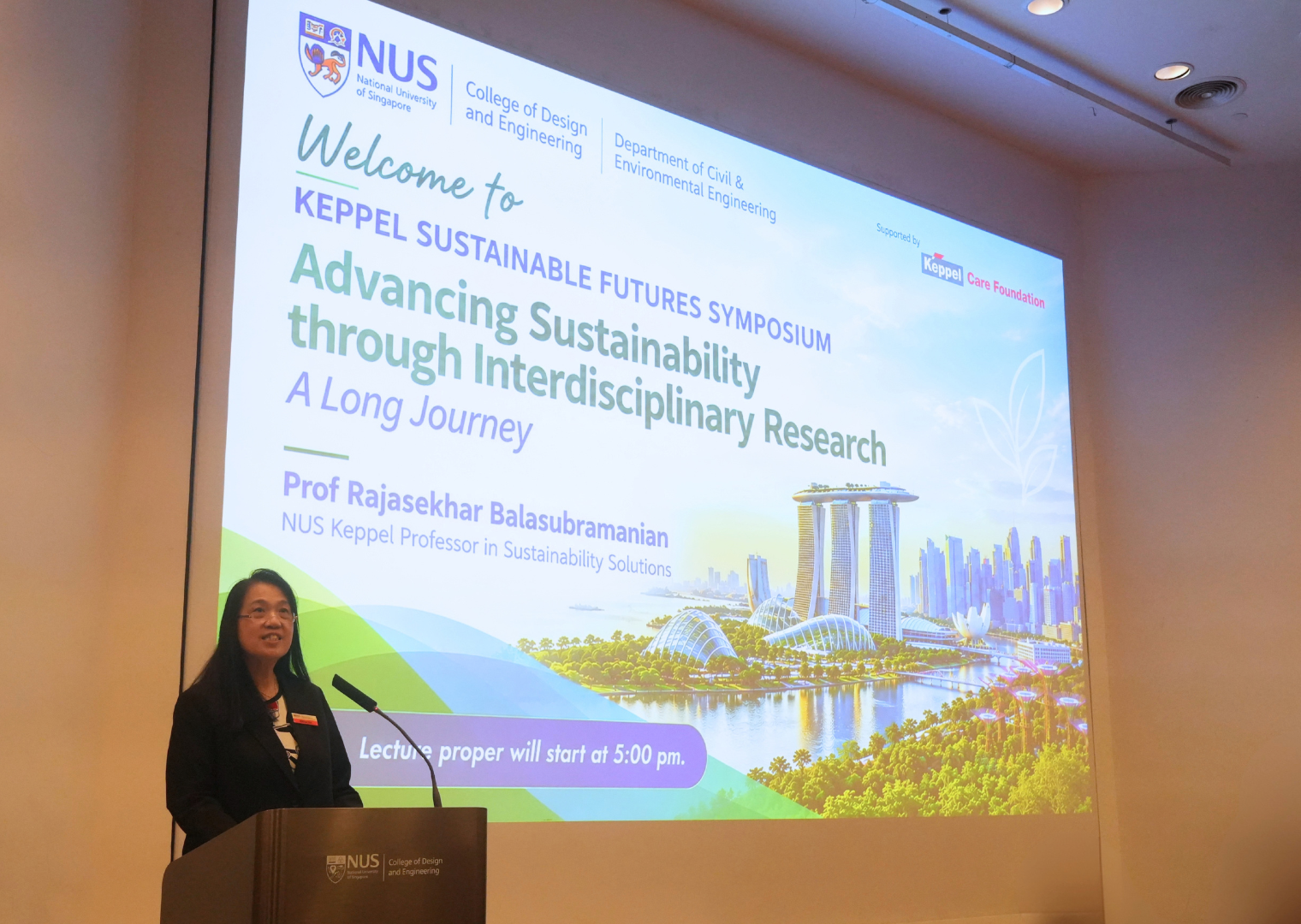
Opening the symposium, Professor Karina Gin, Acting Head of the Department of Civil and Environmental Engineering, echoed the need to work across traditional boundaries.
“Many of these challenges, whether in our cities, infrastructure, energy systems or environment, are complex and interconnected,” she said. “They cannot be addressed by one discipline or one organisation alone.”
The symposium, organised by CEE and supported by the Keppel Care Foundation, was conceived as a platform for researchers, industry and government to exchange perspectives and help translate research and ideas into solutions. It also featured research exhibits from CEE’s Centre for Environmental Resilience and Centre for Resource Circularity and Resilience.
But successful interdisciplinary research takes work, Prof Balasubramanian cautioned. Researchers from different fields bring their own assumptions and ways of working.
“We have to find a common language to engage all our experts coming from other disciplines,” he said. “And it takes time.”
Partnerships also need to be sustained, while institutions and funding bodies have a role in creating conditions in which interdisciplinary research can flourish.
For younger researchers, his advice was not to abandon disciplinary depth in pursuit of breadth. “Certainly you want to do interdisciplinary research, but establish your disciplinary expertise first,” he said. “Make yourself known. Then you take additional risk.”
After three decades of doing just that, his central message was that bringing different fields together is only worthwhile if the combination produces something more.
“Interdisciplinarity is more than putting disciplines together,” he said. “One plus one should be greater than two.”