

“With one haptic device, you are touching the whole planet.”
That was how robotics expert Prof Oussama Khatib described a live global experiment in which teams across multiple countries remotely controlled robots through a single interface, performing manipulation and ultrasound tasks while allowing operators to feel what the robot was touching in real time.
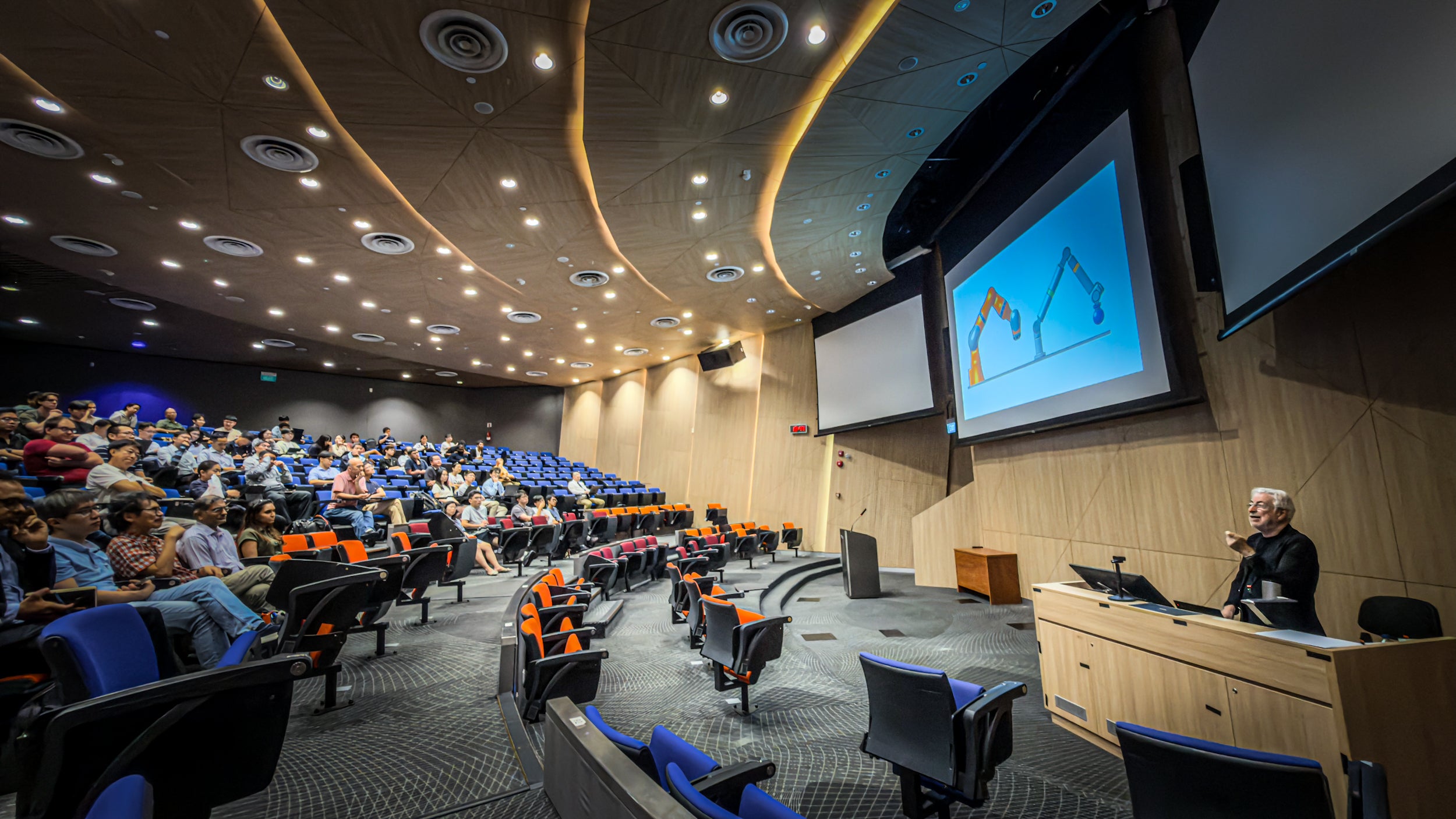
Speaking at the seminar “Shaping the Future of Human-Robot Collaboration” held at CDE on 25 February 2026, a core theme of his talk was that the future of work will not be human or robot. It will be human and robot.
A pioneer in robotics and haptics and Director of the Stanford Robotics Center, Prof Khatib has spent decades advancing how robots move, sense and physically interact with the world. Currently on sabbatical at CDE, hosted by the Advanced Robotics Centre and the Department of Mechanical Engineering, he has been meeting with faculty and students working on underwater robotics, including the NUS Bumblebee team, and holding discussions with PhD students on their research.
In his seminar, delivered to an audience of around 200 students, faculty and robotics practitioners, Prof Khatib emphasised that robotics should amplify human expertise, not replace it.
“If it’s a dangerous place, we are connecting people while distancing them,” he said, connecting their human skills “through the medium of the robot”.
From underwater exploration to enabling remote ultrasound scans in locations without specialist doctors, the focus of Prof Khatib’s talk was on using robots to reach places humans cannot easily or safely go while keeping human expertise firmly in the loop. He illustrated this through OceanOneK, his humanoid underwater robot capable of operating at depths of up to 1,000 metres to support archaeological recovery and scientific missions beyond human reach.
Prof Khatib also explained why collaboration is essential to make this possible. “You cannot really solve big problems in your lab,” he said. Robotics demands more than technical depth in a single discipline. “You need to bring multiple people from multiple backgrounds.” Mechanical design, sensing, control, AI, medicine and real-world application must come together if research is to move beyond theory.
Ultimately, Prof Khatib said, “We are trying to create a bridge between research and the real world.” Human-robot collaboration is not about replacement. It is about partnership grounded in engineering, designed for safety and driven by impact.