


Built from flexible, compliant materials, soft robots are gaining relevance for tasks ranging from minimally invasive surgery to deep-sea exploration but remain held back by a fundamental constraint. To sense their surroundings and react, most soft robots rely on separate electronic sensors, signal-processing circuits and powered actuators, all coordinated by computers. This chain of components adds weight, complexity and points of failure, particularly in wet, hot or high-pressure settings where electronics are highly susceptible to disruption.
A research team at CDE, has developed a mechanical soft force sensor that eliminates this electronic chain entirely. The sensor converts an applied force directly into fluid flow that drives actuators, creating a complete sensing-to-action loop with no computation or external energy. The approach could lead to soft robots that are simpler to build and capable of operating in environments that compromise conventional electronics.
Professor Benjamin Tee (Department of Materials Science and Engineering) and Professor Cecilia Laschi (Department of Mechanical Engineering) led the study, which was published in Science Advances on 8 July 2026. Their sensor, called ME-SOFS (mechanical soft force sensor), uses a purely mechanical structure to detect and separate multi-axis forces and convert them directly into fluidic actuation.
How the sensor works
ME-SOFS is a 3D-printed soft, porous structure built around a central pillar connected to five adjacent fluid-filled chambers, with four positioned horizontally and one vertically. When force is applied, the pillar tilts in that direction, compressing the corresponding chambers and driving fluid through soft tubing towards actuators at the other end. Each chamber responds independently, and thus the sensor can detect and separate forces along three directions: horizontal, lateral and vertical.
The physical push on the sensor becomes fluid movement, and that fluid movement becomes actuation, with no electronic conversion in between. To produce a readable electrical signal alongside this mechanical output, the team incorporated a passive circuit: the displaced fluid moves small magnets past 3D-printed metal arcs, and the changing magnetic flux induces voltage pulses — the same principle that makes a bicycle dynamo generate electricity from wheel rotation. The number of pulses directly corresponds to the magnitude of the applied force, providing a measurable readout without requiring powered electronics.
As the sensor’s design is defined by adjustable geometric parameters, primarily hole diameter, slope thickness and slope angle of the central foam, its sensitivity can be tuned to suit different tasks simply by changing the 3D-printed blueprint.
“We took a unique approach because we were inspired by nature’s ability to scale tactile sensors in many different environments simply using cells, which are essentially largely fluid. We wondered whether a fluid-filled channel could not only sense touch but also directly provide touch feedback to another person. Turns out this design architecture could be achieved with extreme robustness and can be used to train robots for physical AI applications,” stated Professor Tee.
Highly versatile
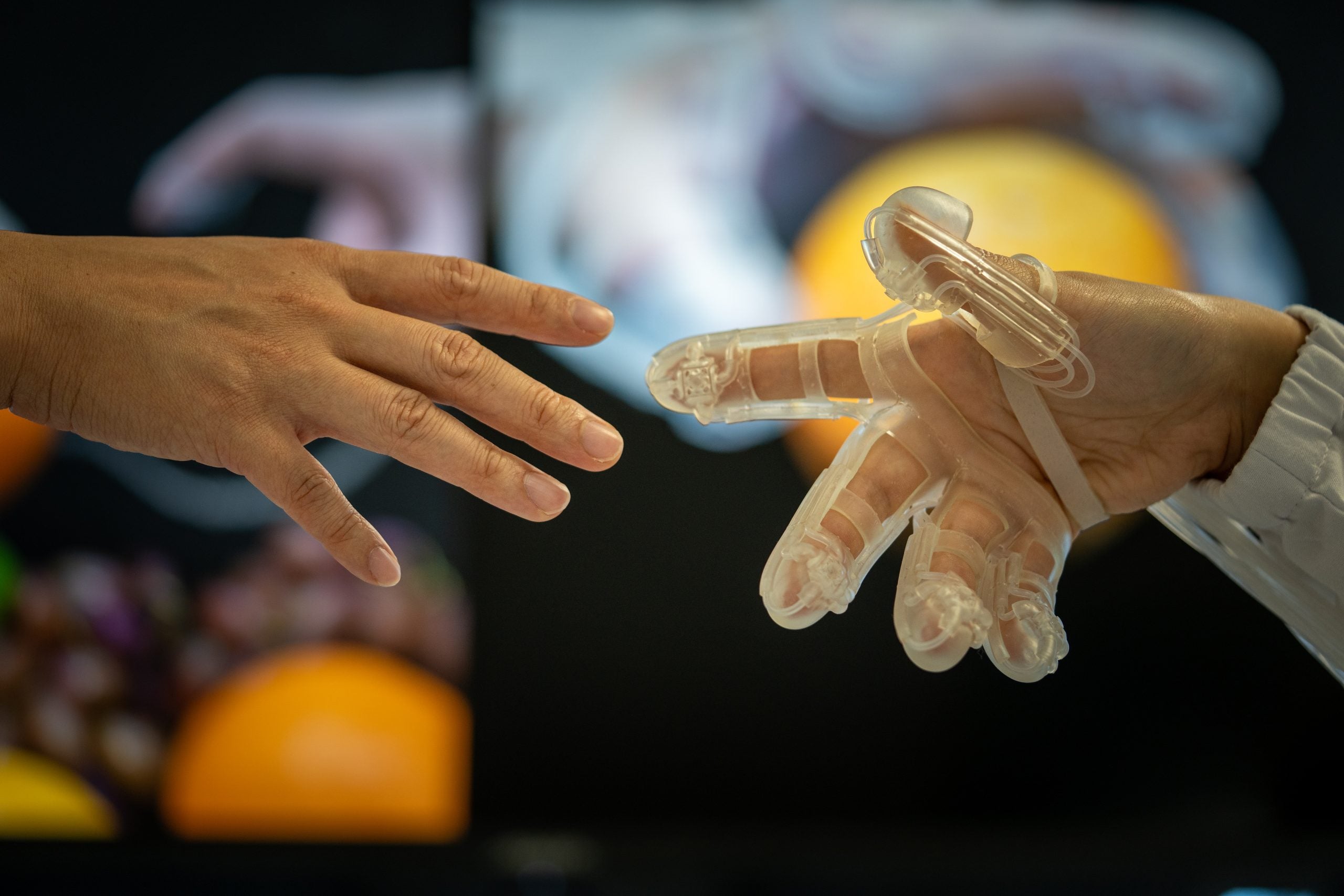
To demonstrate the sensor’s versatility, the team integrated it into several robotic platforms. A soft glove with five miniaturised ME-SOFS units, each roughly the size of a green pea, was 3D-printed in one continuous process from a single material, with no manual assembly. Worn on the hand, the glove detected grasping forces at each fingertip and predicted the weight of held objects, pointing to applications in prosthetics and human-machine interaction.
The team also connected the sensor to a soft haptic pad worn on human fingertips, creating a tactile feedback system. An operator, with eyes covered, controlled a robotic arm’s grasp : the force detected at the gripper travelled as fluid pressure to the pad, giving the operator a direct sense of how firmly the robot was gripping various items, ranging from an egg to wooden blocks to a half-filled water bottle. The signals recorded during a successful grasp were then replayed to teach the robot to replicate the motion autonomously, demonstrating how the sensor can both convey touch in real time and capture data for subsequent training.
The same sensing-to-action loop also steered individual liquid droplets through a miniature fluid controller without any software — relevant for portable medical diagnostics — and drove a set of hair-like flexible structures that bent in response to the direction and strength of the detected force.
ME-SOFS maintained stable performance in hot water (90 degrees Celsius) and under high pressure equivalent to roughly 11 metres depth. Its open-ended fluidic channels equalise with the surrounding water pressure, so the sensor reads only the applied force, not the ambient conditions. It also contains no electronic components, so it is unaffected by the electromagnetic interference that can disrupt conventional sensors.
“This work represents a striking example of how the physical body itself can produce sensory-motor behaviour with no need for a control system, which we may see as an analogy to the nervous system in biology. This form of embodied intelligence, i.e., the mechanical intelligence embedded in the body itself, is widely observed in nature, across species and kingdoms,” said Professor Laschi.
Future work includes exploring diverse applications, thanks to the system's scalability in actuation force and miniaturisation. A direct sensing-actuation loop could be seamlessly integrated into the soft robot's body, enabling an intelligent agent to exhibit almost instinctive behaviour in dynamically changing interactions. The dynamic signals generated by ME-SOFS also encode richer information about applied forces than simple pulse counts, which can be leveraged for more nuanced sensing in complex robotic interactions.
Joint first author Dr Yang Kelu, Research Fellow from the Department of Materials Science and Engineering, said: “By turning force directly into action, without relying on electronics or a processing unit, ME-SOFS has a range of potential applications. In medical training, this could allow trainees to feel the same force feedback as an expert performing a complex movement. In robot-assisted elderly care, it could help a robotic arm respond almost like a reflex, sensing a sudden increase in load during a fall and immediately providing stronger support. This direct sensing-to-action response is what makes the system especially promising for soft robots that need to interact safely with people.”