

RESEARCH NEWS
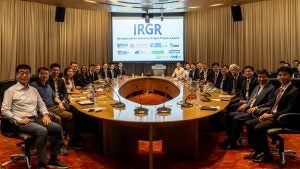
NUS launches project to advance near-zero emissions ammonia marine engines
Industry–academia collaboration to be based at CDE targets decarbonisation of the global shipping industry through new ammonia-fuelled engine concept.
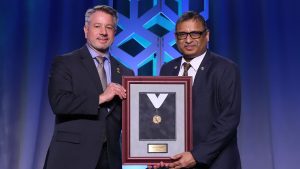
Prof Chandra Sekhar receives ASHRAE F. Paul Anderson Award
Award recognises “globally respected leader” who has made “lasting contributions through his technical expertise, research leadership, and dedicated service.”
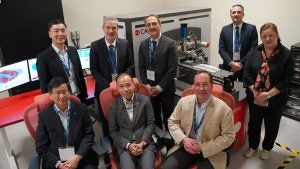
First atom probe tomography facility in SE Asia opens at NUS
Invizo 6000 Atom Probe Tomography Facility supports research in semiconductors, advanced alloys, energy materials and nanotechnology.

AI powers collaboration in climate predictions
NUS CDE researchers helped develop an AI method that keeps long-term climate simulations stable and accurate.
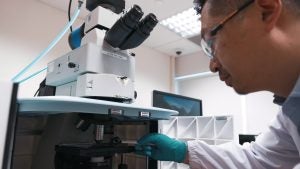
Durability breakthrough for tandem solar cells
Use of vapour deposition on industrial silicon wafers supports higher-efficiency solar energy generation and accelerates path to real-world deployment.
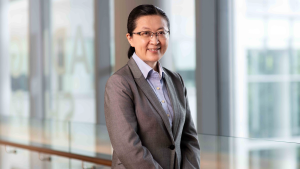
Prof Liu Bin named fellow of the National Academy of Inventors
NAI Felllowship recognises inventors whose work has led to real-world impact through patented technologies.
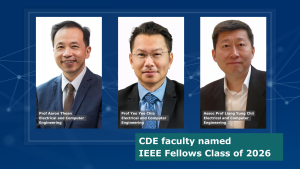
Three CDE faculty named IEEE Fellows for 2026
Prof Aaron Thean, Prof Yeo Yee Chia and Assoc Prof Liang Yung Chii recognised for outstanding contributions to electrical and computer engineering.
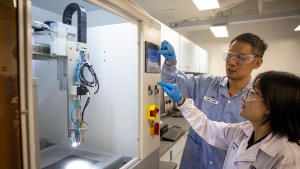
Asst Prof Lum Yanwei honoured with 2025 WIN Rising Star Award
Chemical and Biomolecular Engineering researcher recognised for his innovative nanotechnology research on turning waste CO2 emissions into valuable products.
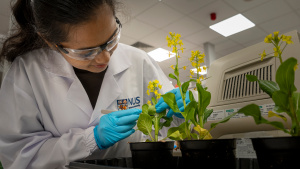
Microneedles boost plant growth with less fertiliser waste
Dissolving patch delivers beneficial microbes directly into leaves and stems, speeding growth in vegetables while using over 15 per cent less biofertiliser.
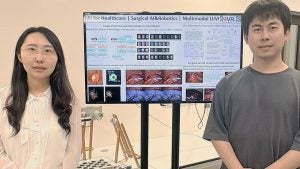
Medical AI to see, reason and anticipate
Assistant Professor Jin Yueming is developing AI that can perceive, reason and act with clinical intuition.
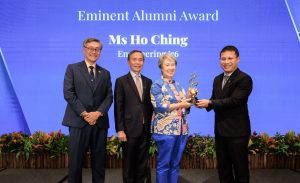
Six CDE alumni honoured at NUS Alumni Awards
Ms Ho Ching presented with NUS Eminent Alumni Award at ceremony recognising University alumni who have distinguished themselves through significant and impactful contributions.

Magnetic fields power smarter soft robots with built-in intelligence
A soft robot inspired by the manta ray utilises magnetic fields to both move and recharge its onboard power supply, enabling it to perform autonomous sensing.