
RESEARCH

How much power could Singapore’s tides really deliver?
A team led by Associate Professor Low Ying Min (Civil and Environmental Engineering) at CDE used high-resolution, turbine-scale ocean simulations to map where Singapore’s tidal currents are strongest, and how much electricity could be generated under practical siting constraints.
Hosted by the Centre for Offshore Research and Engineering, the study highlights hotspots in the Singapore Strait and around western island channels, then compares different tidal turbine designs for realistic output. Under the study’s assumptions, tidal stream energy could reach up to 12.85 Terawatt-hour (TWh) per year — about 22% of Singapore’s 2023 electricity demand — with an estimated 6.03 million tonnes of CO₂ avoided annually.
Read more here: https://cde.nus.edu.sg/news/high-resolution-simulations-reveal-singapore-tidal-stream-energy-potential/
Harnessing nanotechnology to protect and strengthen plants
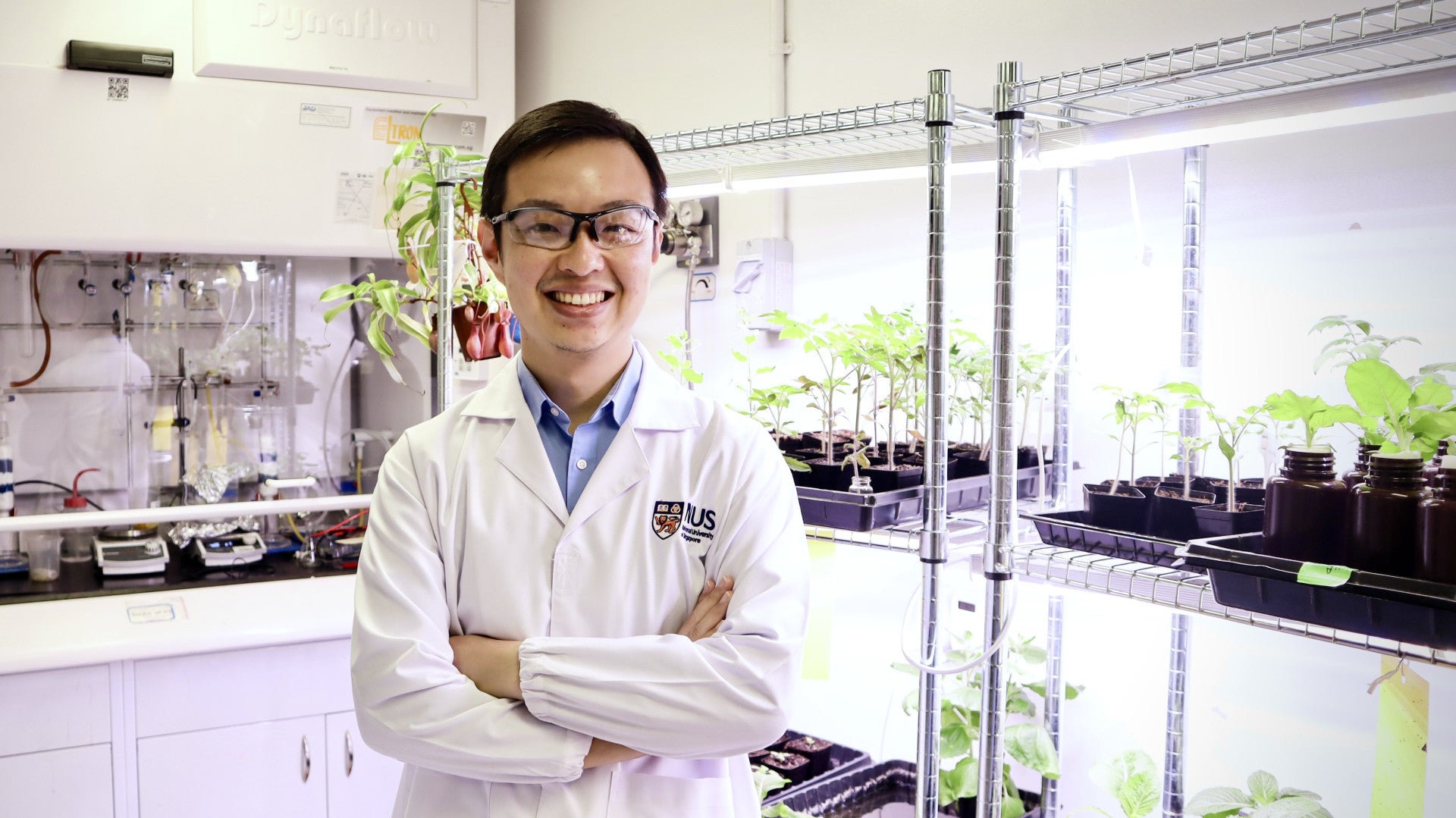
As a child with a keen eye for scientific inquiry, Assistant Professor Tedrick Lew (Chemical and Biomolecular Engineering) observed his mother glance at a backyard plant and decide, almost instantly, whether it was thriving or struggling. He could not always see what she saw. However, the question lingered: could plant health be measured early, clearly and without harming the plant?
That same curiosity now underpins his research — building tools that can both detect early signs of stress and deliver targeted help into living plants. His latest work tackles one of the most stubborn bottlenecks in plant science: getting useful “cargo”, such as genes, proteins, hormones and even beneficial microbes, into living plants efficiently, especially when leaves are wet or fully submerged.
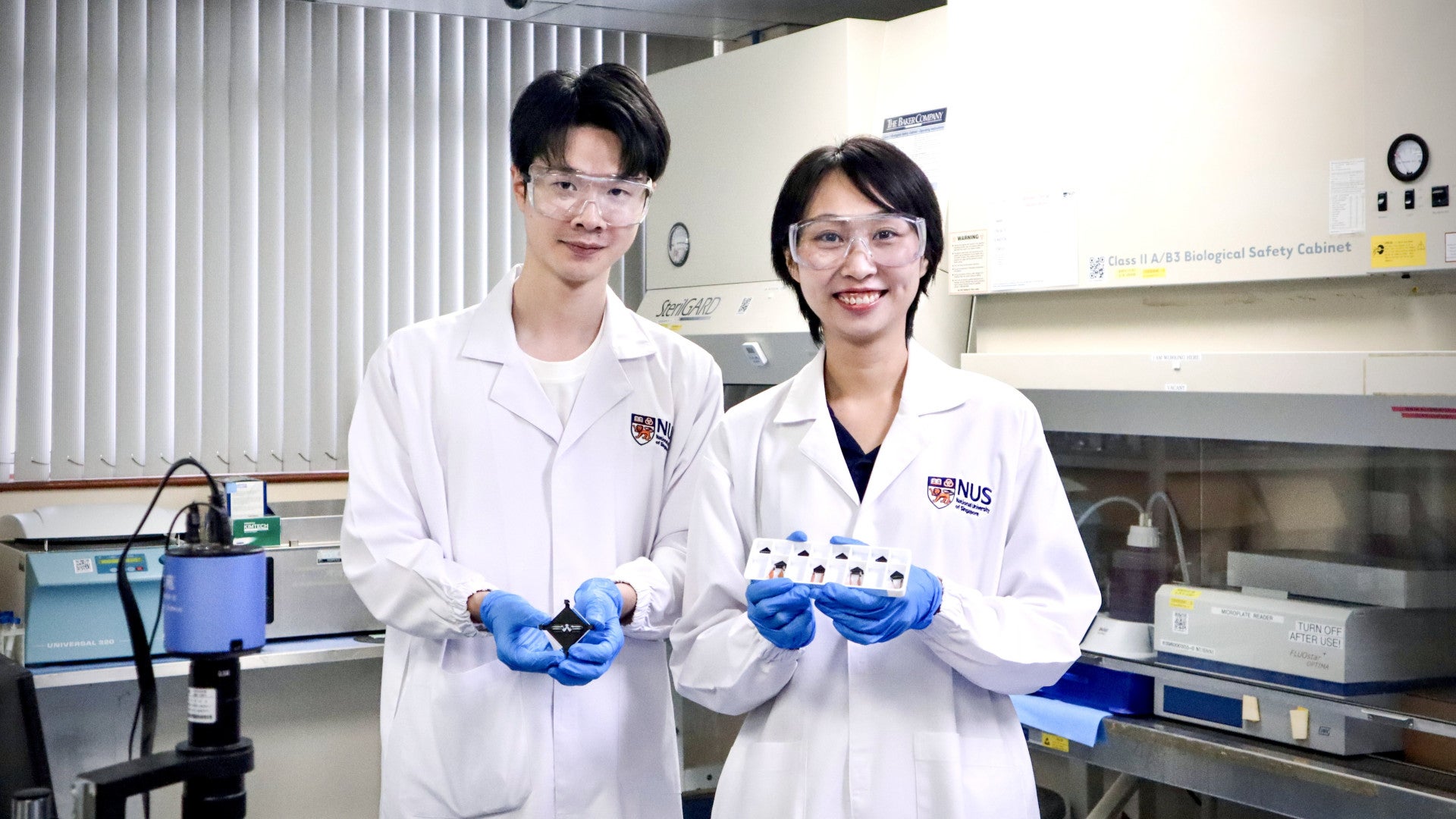
To address this, Asst Prof Lew and his team built a tiny patch covered in short microneedles that gently create microscopic pathways into plant tissue. Each microneedle is designed like a protective capsule: an outer layer helps it resist water exposure long enough for handling and application, while the inner core holds sensitive cargo. Once inserted, plant fluid gradually triggers a release mechanism, helping to push the payload into the surrounding tissue at a controllable pace.
Read more here: https://cde.nus.edu.sg/news/harnessing-nanotechnology-to-protect-and-strengthen-plants/
Wearable sensor enables real-time tracking of fatigue and mental health
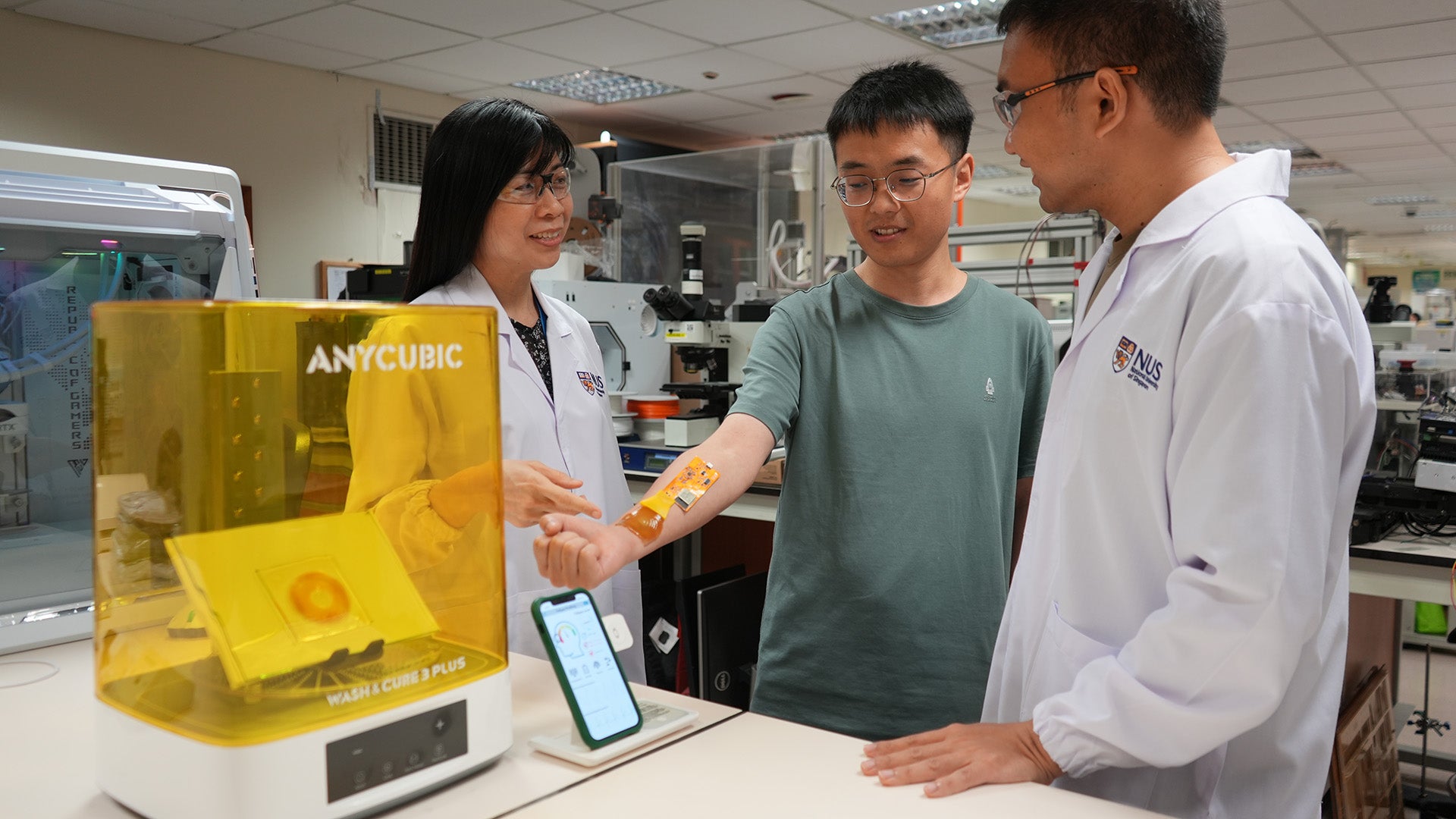
A wearable sensor developed by researchers at CDE enables clinical-grade monitoring of fatigue and mental health in real-world settings, even during movement — overcoming a major limitation of existing devices.
By combining a soft, skin-conforming hydrogel with AI-driven signal processing, the system captures accurate heart and blood pressure signals on the move, paving the way for continuous, objective tracking of mental-health states.
The research team, led by Professor Ho Ghim Wei (Electrical and Computer Engineering) with Dr Tian Guo as first author, developed a metahydrogel platform that suppresses multiple sources of motion noise simultaneously. The system achieves clinical-grade performance, delivering an electrocardiograph signal-to-noise ratio of 37.36 dB and blood pressure deviation as low as 3 mmHg during movement.
Combined with machine learning, the platform can classify fatigue levels with 92 per cent accuracy, pointing towards objective, continuous mental health monitoring outside clinical settings.
Read more here: https://cde.nus.edu.sg/news/wearable-sensor-enables-real-time-tracking-of-fatigue-and-mental-health/
DID secures $500,000 grant to advance teen online safety research

The Division of Industrial Design’s Assistant Professor Janghee Cho, Assistant Professor Clement Zheng and their team of collaborators have secured $500,000 in funding from the Centre for Advanced Technologies in Online Safety (CATOS).
Assistant Professor Cho, Principal Investigator and director of the division’s Joyful Experiences in Design and Interaction (JEDI) Lab, and Assistant Professor Zheng, co-Principal Investigator and director of the Interactive Materials Lab, are working with collaborators from NUS Social Work, Singapore Management University (SMU), The Hong Kong Polytechnic University and RMIT University.
Their research project, “Rethinking Online Safety: Empowering Teens and Communities through Sociotechnical Design”, was developed in response to growing concerns about online safety and teen digital well-being.
Rather than treating online safety solely as a technical or enforcement issue, the project approaches it as a matter of care, education, empowerment and sociotechnical support. The team aims to design teen-centred social technologies that support healthier and safer relationships with mobile and AI-mediated digital environments in Singapore. Instead of relying on traditional methods such as surveillance, restriction or parental control, the project helps teens build reflection, self-regulation and agency.
CATOS, which awarded the grant, focuses on building robust technological capabilities to combat online harms. The centre was launched by A*STAR, a government agency for Science, Technology and Research in Singapore. The project was funded under CATOS’s Tech for Community Empowerment category.
DID congratulates Assistant Professor Janghee Cho and Assistant Professor Clement Zheng on this achievement and looks forward to the meaningful impact their research will bring to online safety for youth and communities.
Self-training muscle could power a new generation of biodegradable robots
A new platform that lets lab-grown muscle tissues train themselves to record-breaking strength could enable stronger muscle-powered robots for applications such as minimally invasive medical procedures and biodegradable sensors.
Researchers at CDE developed the platform by mechanically coupling two muscle tissues so they continuously pull against each other, turning their natural contractions into a round-the-clock workout. The resulting muscles powered OstraBot, a swimming robot inspired by the boxfish, that reached a speed of 467 millimetres per minute, the fastest reported for any skeletal muscle-driven biohybrid robot.
The advance removes a long-standing bottleneck in biohybrid robotics - machines driven by living cells rather than conventional motors. Because muscle-based actuators are soft, quiet and efficient at small scales, stronger versions could unlock minimally invasive biomedical tools, soft environmental sensors and fully biodegradable robots that safely degrade after completing their task.
“For years, researchers have been interested in building robots powered by living muscle because biological actuation is soft, adaptive and energy-efficient at small scales. However, the performance of these systems has been limited by the low force output of cultured skeletal muscle. If the actuator is weak, the robot cannot move fast, generate meaningful thrust, or perform useful tasks,” said Assistant Professor Tan Yu Jun (Mechanical Engineering), who led the research.
Read more here: https://cde.nus.edu.sg/news/self-training-muscle-could-power-a-new-generation-of-biodegradable-robots/
Major Grants Awarded
The major grants (start date in March 2026) with total project value > $1M.
| Hosting Unit | Project Title | Funding Programme (Source of Funding) |
Principal Investigator | Co-Investigator |
| DBE | Mixed-mode ventilation in schools: impact on learning, comfort and energy | Cities of tomorrow R&D programme: Greater sustainability – 2025 | Associate Professor Chong Zhun Min Adrian | Associate Professor Tay En Rong, Stephen; Associate Professor Wong Hwee Boon Daniel; Assistant Professor Lo Chi Yan (Medicine); Mr Bertrand Lasternas (UCI) |
| ME | Development of an Unmanned Inspection and Maintenance System for On-site Repair and Re-lining of PWCS Pipes | Cities of tomorrow R&D programme: Resilient infrastructure – 2023/NRF | Associate Professor Chew Chee Meng | |
| ECE | CogniVision AI cameras for ubiquitous, zero-wire and zero-maintenance surveillance | Smart Nation and Digital Government Translational R&D (TRANS2.0) Grant – 2025/MDDI | Professor Alioto, Massimo Bruno | |
| DBE | MIDAS: Multimodal LLM-driven Intelligent Design-for-Safety Advisory System | Smart Nation and Digital Government Translational R&D (TRANS2.0) Grant – 2025/MDDI | Associate Professor Goh Yang Miang | Associate Professor Yeoh Ker-Wei, Justin |
| ME | Development of a non-intrusive, seedless technique for high-speed 1-d velocimetry using ultrashort laser pulses | DSO National Laboratories | Assistant Professor Chng Tat Loon | |
| BME | Development of a Removable, Superhydrophobic Hemostatic Platform for Safe Bleeding Control in Surgical and Trauma Settings | NRF Central Gap Fund – 2025/NRF | Associate Professor Leo Hwa Liang |