

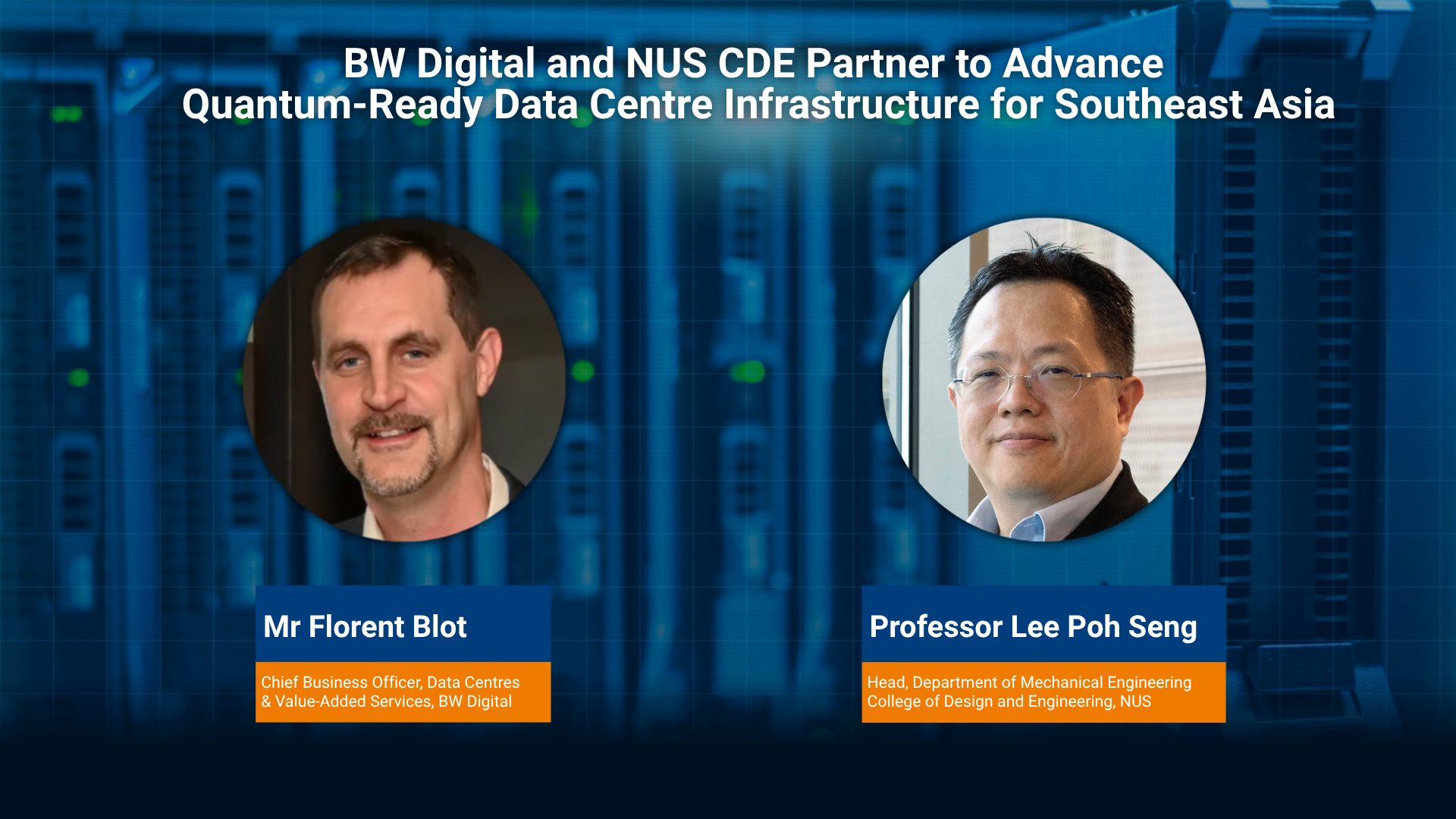
NUS CDE and BW Digital have announced a strategic research collaboration to develop the engineering foundations for next-generation quantum-ready digital infrastructure in Southeast Asia’s tropical environments.
The partnership was announced at DCD>Connect | APAC 2026, Data Centre Dynamics’ flagship digital infrastructure conference. It marks a deeper engagement by BW Digital with Singapore’s AI and quantum research ecosystem, while supporting the company’s investments in future-ready digital infrastructure.
The initiative also aligns with Singapore’s ambitions to strengthen its leadership in artificial intelligence, high-performance computing and quantum technologies, while reinforcing its position as a key regional data centre hub.
Defining the infrastructure needed for hybrid quantum-classical computing
Over the next 18 months, the collaboration will focus on defining the “minimum viable infrastructure envelope” required to support future quantum-classical computing integration within modern data centres. Research areas will include thermal, cryogenic and power systems; structural design and environmental stability; and quantum-safe integration, connectivity, and operations.
A key focus will be understanding how tropical operating environments such as Singapore and Batam create distinct infrastructure challenges for quantum systems, particularly in humidity management, heat rejection, vibration control and electromagnetic stability.
Researchers and engineers from BW Digital and NUS CDE’s Department of Mechanical Engineering will evaluate deployment typologies, readiness scorecards and infrastructure zoning strategies to support future hybrid AI-quantum workloads across Southeast Asia.
The collaboration will also establish an operator playbook to guide BW Digital’s future site selection, vendor engagement and infrastructure planning.
Supporting regional capability building
As global standards for quantum-classical infrastructure continue to evolve, the collaboration is also expected to support workforce capability building, regional knowledge development and future infrastructure reference architectures for Southeast Asia.
Professor Lee Poh Seng, Head of the Department of Mechanical Engineering at NUS CDE, said, “As Southeast Asia continues to grow as a strategic digital infrastructure hub, future competitiveness will depend not only on capacity, connectivity and energy efficiency, but also on readiness for emerging advanced technologies such as quantum computing. This collaboration with BW Digital allows us to bridge academic research with real-world infrastructure development, and to help define practical engineering requirements and operational frameworks for quantum-ready facilities in tropical environments. By combining NUS’s engineering expertise with BW Digital’s industry perspective, we aim to contribute to resilient, secure and future-ready digital infrastructure for the region.”