



INDUSTRY & INNOVATION
Team MAELSTROM takes top prize at Singapore Defense Tech Hackathon 2026
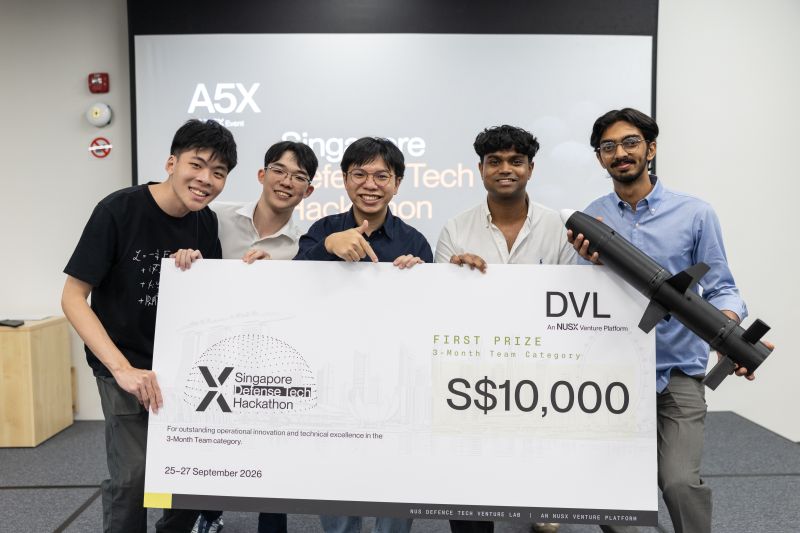
“Such an interdisciplinary approach is the very thing CDE champions, and this experience showed us its value firsthand. I’m grateful to my teammates for making this possible, and to NUSX for the opportunity.” – Vaikesh Manimaran (Year 3, Mechanical Engineering), MAELSTROM Project Lead & Avionics Engineer
Team MAELSTROM has taken the top prize at the inaugural Singapore Defense Tech Hackathon 2026 with an ambitious approach to a growing defence challenge: how to counter large-scale drone swarms quickly and cost-effectively.
The Singapore Defense Tech Hackathon was organised by NUSX(opens in new tab), with the European Defense Tech(opens in new tab) Hub (EDTH) and TUM Venture Labs(opens in new tab) as co-organisers. It brought together participants from Singapore and abroad to develop solutions to real-world defence challenges, with participants working alongside defence technology experts and mentors to develop and test their ideas.
The five-member MAELSTROM team — comprising Vaikesh Manimaran (Year 3, Mechanical Engineering), Sunith Sunil Mani (Year 3, Mechanical Engineering), Ding Yi He (Year 4, Computer Science), Joel Marc Tan (SUTD) and Solomon Lim (NUS High School) — developed a rocket-propelled anti-drone interceptor designed to reach speeds in the 1,000 km/h class. Rather than focusing solely on the performance of an individual interceptor, the team also considered how the system could be produced rapidly and at scale.
Their solution was designed around additive manufacturing, with both the interceptor and its propellant intended to be 3D-printable. This approach aims to enable lower-cost, rapid mass production, an important consideration when responding to threats involving large numbers of comparatively inexpensive drones. Bringing the concept together required expertise across avionics, optics, structures, propulsion and software. In just five weeks, the team worked across these disciplines to develop and test the idea as part of the hackathon.
Vaikesh said, “Winning the Singapore Defense Tech Hackathon’s Grand Prize means a great deal to us. We joined a three-month track with just five weeks remaining, so building an inert interceptor prototype was a tall order. Each teammate brought a different engineering perspective, and bringing those disciplines together was central to what we achieved.”
The Grand Prize comes with S$10,000, with MAELSTROM also having the possibility of a S$100,000 incubation opportunity. The team is now exploring how to take the project further as a defence technology venture, including opportunities in advanced additive manufacturing.
CDE Innovation Day 2026 showcases innovative ideas with real-world potential
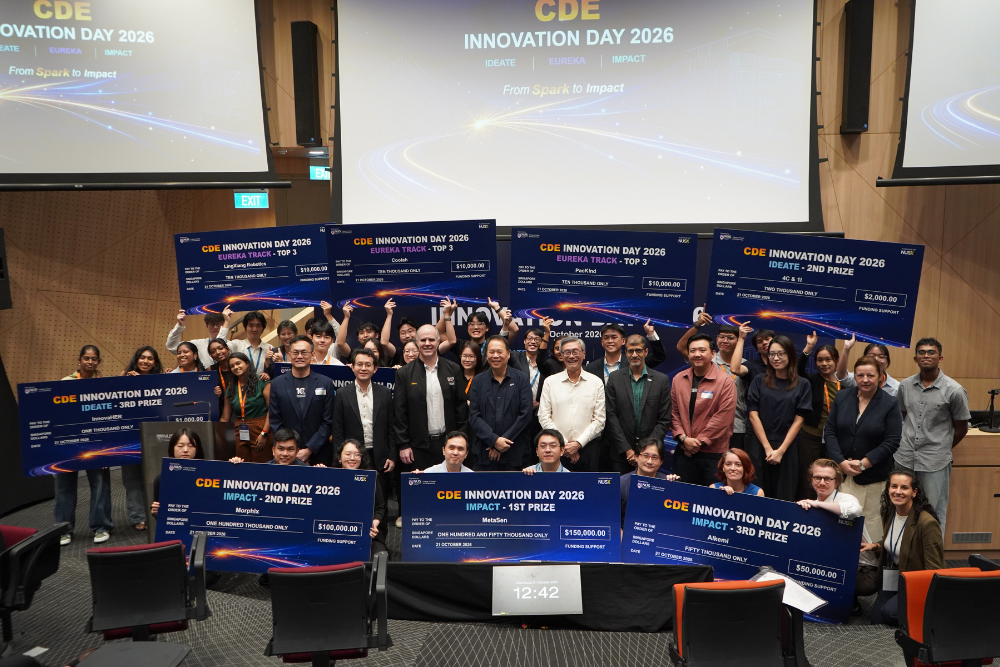
Innovative ideas spanning healthcare, assistive technology, robotics, sustainable energy and advanced manufacturing took centre stage at CDE Innovation Day 2026, as students and researchers from across NUS competed for funding to advance their projects.
Held on 21 October, the event brought together participants ranging from first-year undergraduates to graduate students and researchers, highlighting the breadth of innovation and entrepreneurial ambition within the NUS community.
Under this year's theme, “From Spark to Impact”, teams presented their projects across three competition tracks, each designed to support innovations at different stages of development. The IDEATE competition focused on early-stage ideas, EUREKA supported proof-of-concept development, while IMPACT centred on research translation and venture creation.
This year's competition attracted a significant increase in applications across all three tracks, with enhanced funding support available to help winning teams take their ideas further.
Read more here.
AM.NUS supports 3D printing adoption in Singapore’s agriculture sector

On 14 August, researchers Huang Kai Xing and Ambrose Chuan from CDE’s AM.NUS supported a 3D Printing Workshop organised by the Agritech Translation Programme (AgTP), a joint initiative by the Singapore Food Agency (SFA) and the National University of Singapore (NUS). The workshop was also supported by the NUS Department of Biological Sciences (DBS) Regenerative Agritech Centre and CDE’s Engineering Design and Innovation Centre (EDIC).
The workshop introduced farmers to practical applications of 3D printing in farm operations, particularly in spare parts replacement and digital inventory management.
For many farms, replacing equipment parts can involve long lead times, minimum order quantities and challenges associated with low- to mid-volume production. Participants explored how 3D printing could offer a more flexible alternative, enabling farms to produce selected parts on demand, reduce reliance on physical stockpiles and manage spare parts inventory digitally.
The workshop also encouraged participants to consider broader applications of additive manufacturing in agriculture, from rapid prototyping to customised tools and farm-specific solutions. These applications align with AgTP’s mission to drive technology translation and adoption by bringing together public agencies, institutes of higher learning, research institutes and industry partners to adapt innovations for Singapore’s agriculture sector.
Through the expertise of researchers at AM.NUS and support from EDIC, CDE continues to contribute to efforts to translate emerging technologies into practical solutions, helping to build a more resilient, adaptable and innovation-ready agricultural sector.
Start with the problem, not the discipline: Rethinking solutions to sustainability challenges
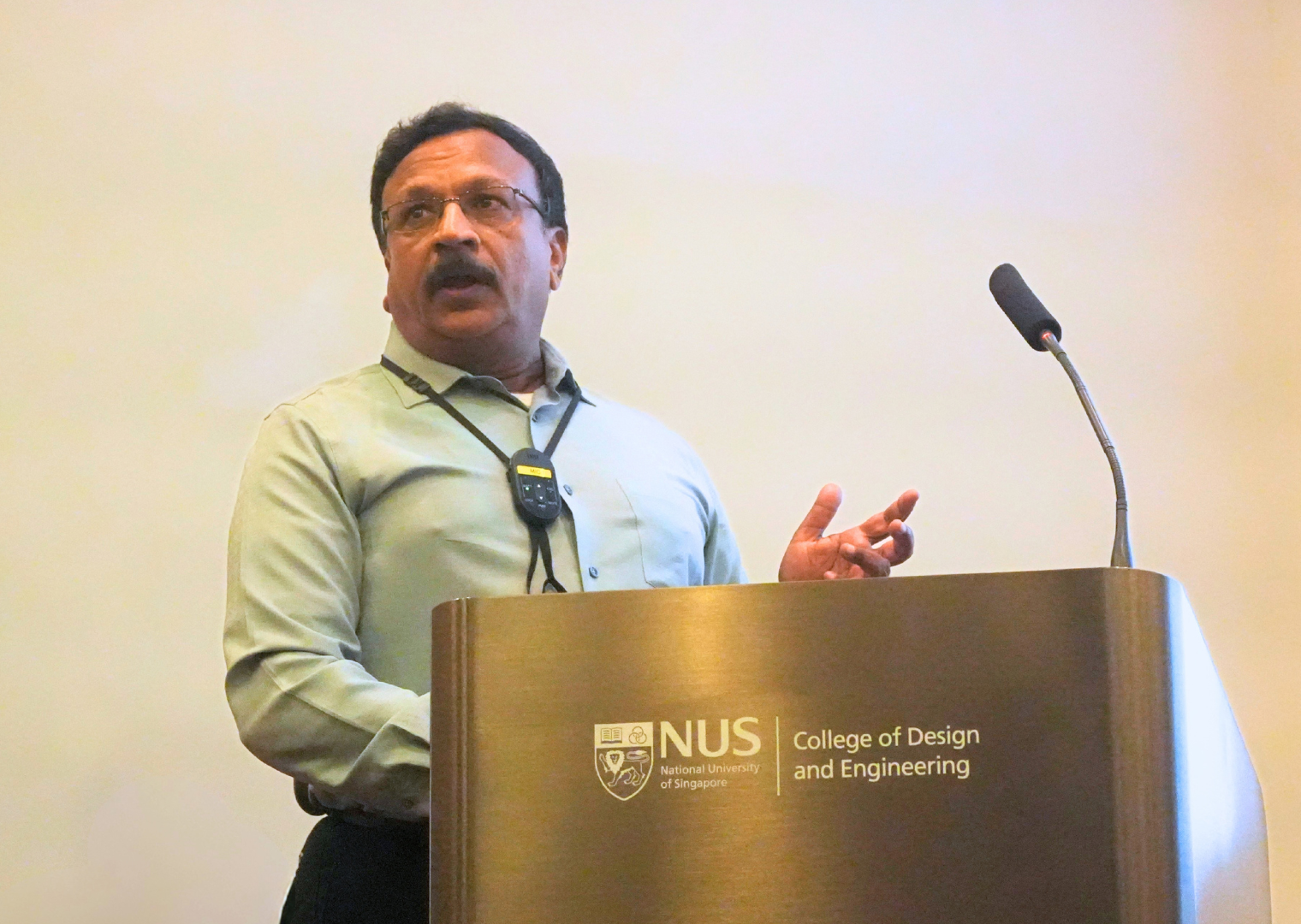
“We should not get intimidated by the challenges we have, but instead we should be excited by the opportunities available for innovation.” For Professor Rajasekhar Balasubramanian (Bala), tackling complex sustainability challenges means looking beyond the boundaries of any single field.
Speaking at the inaugural Keppel Sustainable Futures Symposium, organised by CEE, supported by the Keppel Care Foundation, and held at CDE in conjunction with NUS Sustainability CONNECT, Prof Balasubramanian reflected on almost three decades of research and collaboration, and the lessons he has learned about bringing different forms of expertise together to address real-world problems.
From indoor air quality and urban greenery to stormwater management, transport and decarbonisation, Prof Balasubramanian highlighted how increasingly interconnected challenges demand an equally integrated response. Cities, he noted, are a “system of systems”, where decisions involving transport, energy, the built environment and other sectors cannot be considered in isolation.
Prof Balasubramanian, the inaugural NUS Keppel Professor in Sustainability Solutions, also stressed the importance of taking research beyond academia. Addressing problems of societal concern means working with industry, government agencies, practitioners and communities to translate knowledge into practical solutions.
And with many sustainability goals stretching beyond the career of any individual researcher, education is equally important. Prof Balasubramanian highlighted the need to equip the next generation with the interdisciplinary perspectives needed to become problem-solvers and critical thinkers.
His central message: “When it comes to interdisciplinary collaboration, start with the problem, not the discipline.”
Read more here.
Johnson Controls joins STDCT 2.0 to optimise cooling, power and control systems for sustainable AI data centres
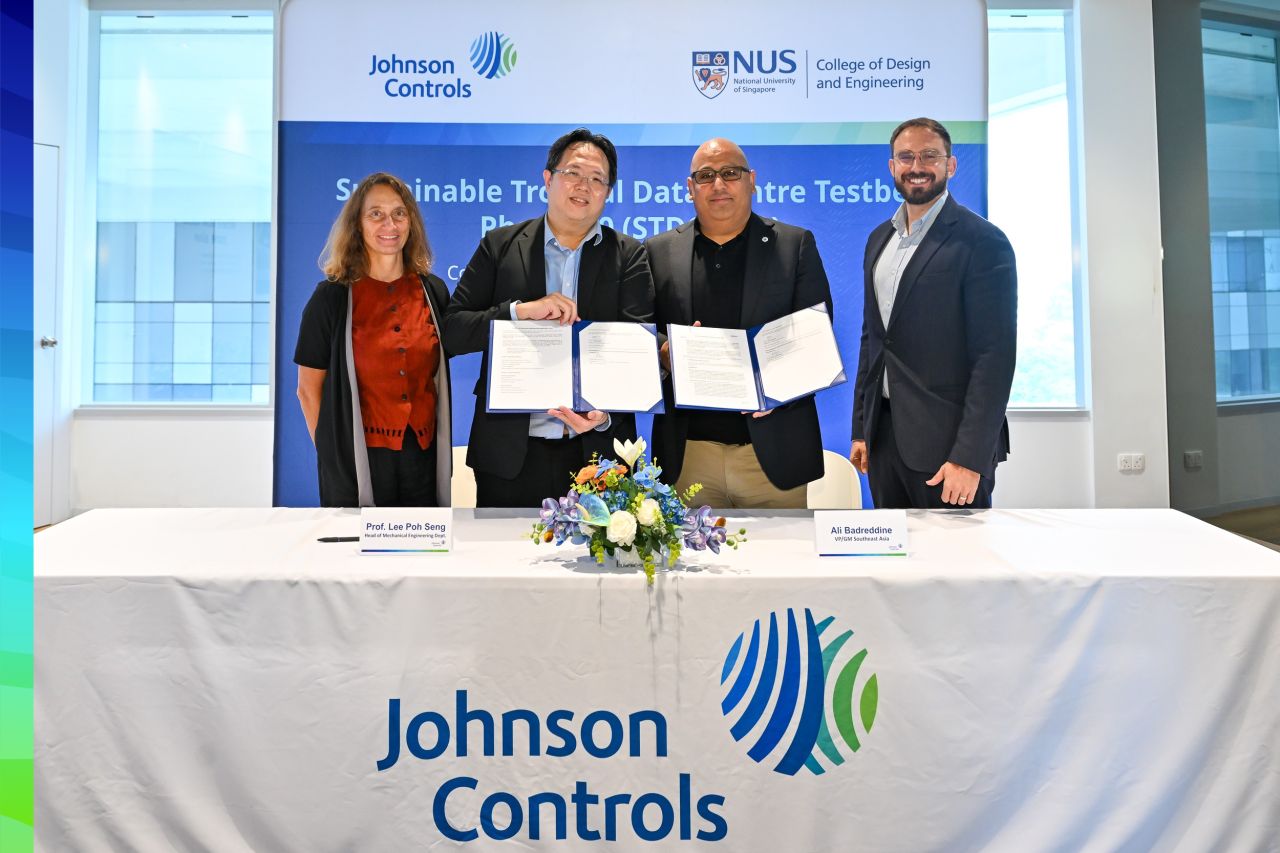
The Sustainable Tropical Data Centre Testbed 2.0 (STDCT 2.0), hosted at CDE, is tackling a key challenge: how to support the rapidly growing computing demands of AI while keeping data centre energy, cooling and resource requirements sustainable, particularly in hot and humid tropical conditions.
Johnson Controls Asia Pacific has now joined STDCT 2.0, bringing expertise in thermal management, smart controls, engineering and mission-critical infrastructure to the programme. Together with CDE, Johnson Controls will explore how cooling, power and control systems can be integrated and optimised to support greater AI computing capacity while reducing resource consumption.
Prof PS Lee, Programme Director of STDCT 2.0 and Head of NUS Mechanical Engineering, said, “STDCT 2.0 is designed to move beyond individual technologies and evaluate how these systems can be integrated and optimised as one infrastructure platform under real tropical operating conditions. Johnson Controls brings deep expertise in thermal management, controls and mission-critical infrastructure to this collaboration.”
Beyond technology evaluation, the collaboration will also support advanced research, talent development, workforce training, innovation and knowledge sharing, further strengthening STDCT 2.0 as a platform for translating research into deployable solutions for Singapore and other tropical markets.