Master of Science, Integrated Sustainable Design
Why MSc ISD has a Lab
The Design Lab exists because questions raised in the teaching studios – carbon, land use and urban form, role of policy – cannot be fully explored over the course of a 12-week semester. They live on to become funded research, and sometimes a PhD topic. Research sponsors are often industry partners and public agencies.
The relationship between teaching and research runs both ways. Tools built in the Lab, such as the ISD Carbon Calculator, are directed back into coursework. And some students join the Lab as interns or research assistants during semester breaks or after graduation.
Research Projects
Adaptive Reuse and Densification as a Carbon Strategy
Funding Agency: Centre for Liveable Cities (CLC), Ministry of National Development, Singapore
Project Period: August 2025 – February 2026
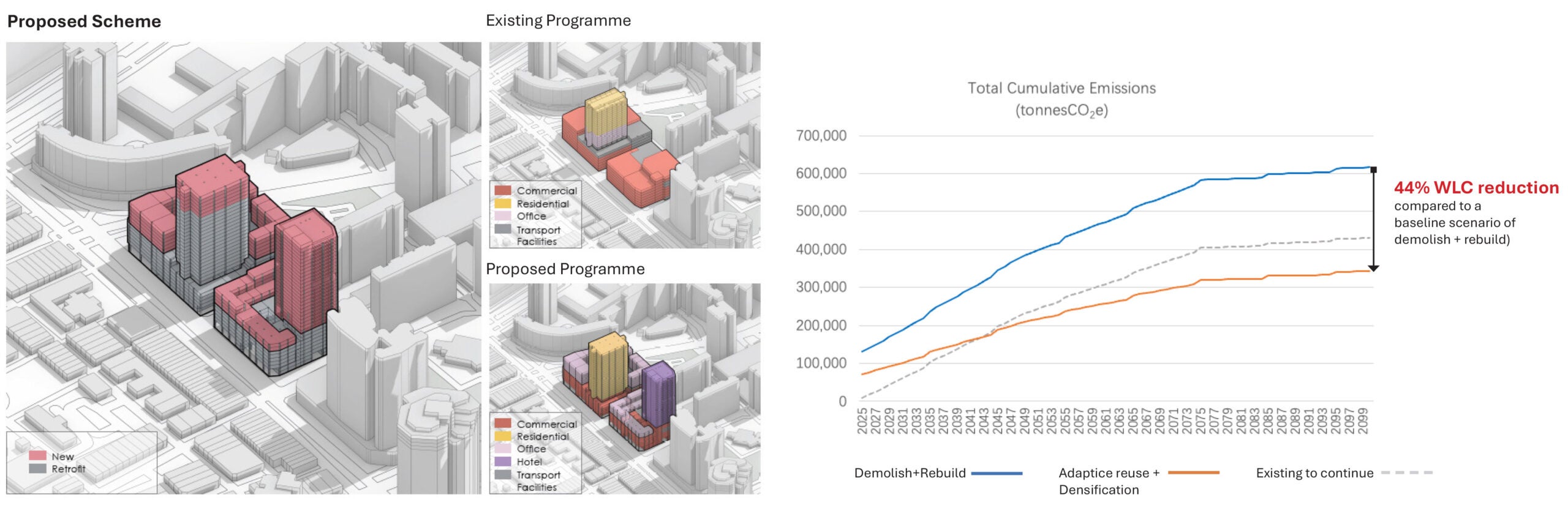
| This study examined whether adaptive reuse combined with land-use densification can offer a lower-carbon alternative to demolition and redevelopment in Singapore. Through a studio-based design-research exercise, the project tested this question across four typologies using policy review, case studies, and speculative design.
The research reframes adaptive reuse as both a carbon and planning strategy, with wider benefits for urban continuity and community life, while supporting stronger carbon reporting and optioneering requirements for redevelopment decisions. A summary of this study was published in a CLC publication Beyond Sustainability: Building a Regenerative Future for Our Cities – pages 90-93. |
Environmental Policy in Singapore’s Built Environment: Co-Benefit Analysis at the Urban Scale
Funding Partner: Real Estate Developers’ Association of Singapore (REDAS)
Project Period: January 2025 – May 2026
| In collaboration with NUS’ Sustainable and Green Finance Institute (SGFIN), this study examined how environmental policy and actions generate, transfer and hold value for multiple stakeholders. The findings offer a complete account of how that value is distributed, offering insight into the link between policy instruments, developer investments, asset performance and wider stakeholder benefits. |
Carbon-Neutral Tall Buildings
Funding Partner: Centre for Vertical Urbanism (CVU, formerly CTBUH)
Project Period: August 2024 – May 2025
| Can tall buildings, in time, attain carbon neutrality? The research mapped the future of solar photovoltaics (PV) and concrete and assessed their impact on projects in Singapore. Analyses showed that advances in PV and low-carbon concrete after 2035 could significantly reduce life-cycle emissions. The study posited that buildings designed today could anticipate these shifts through architectural forms that accommodate future upgrades, allowing progressive emissions reduction and, under favourable scenarios, approach carbon neutrality. The published article is available at Vertical Urbanism Issue SIX I/ 2026 |
Transforming Sungei Kadut
Funding Agency: JTC Corporation
Project Period: August 2020 – May 2021
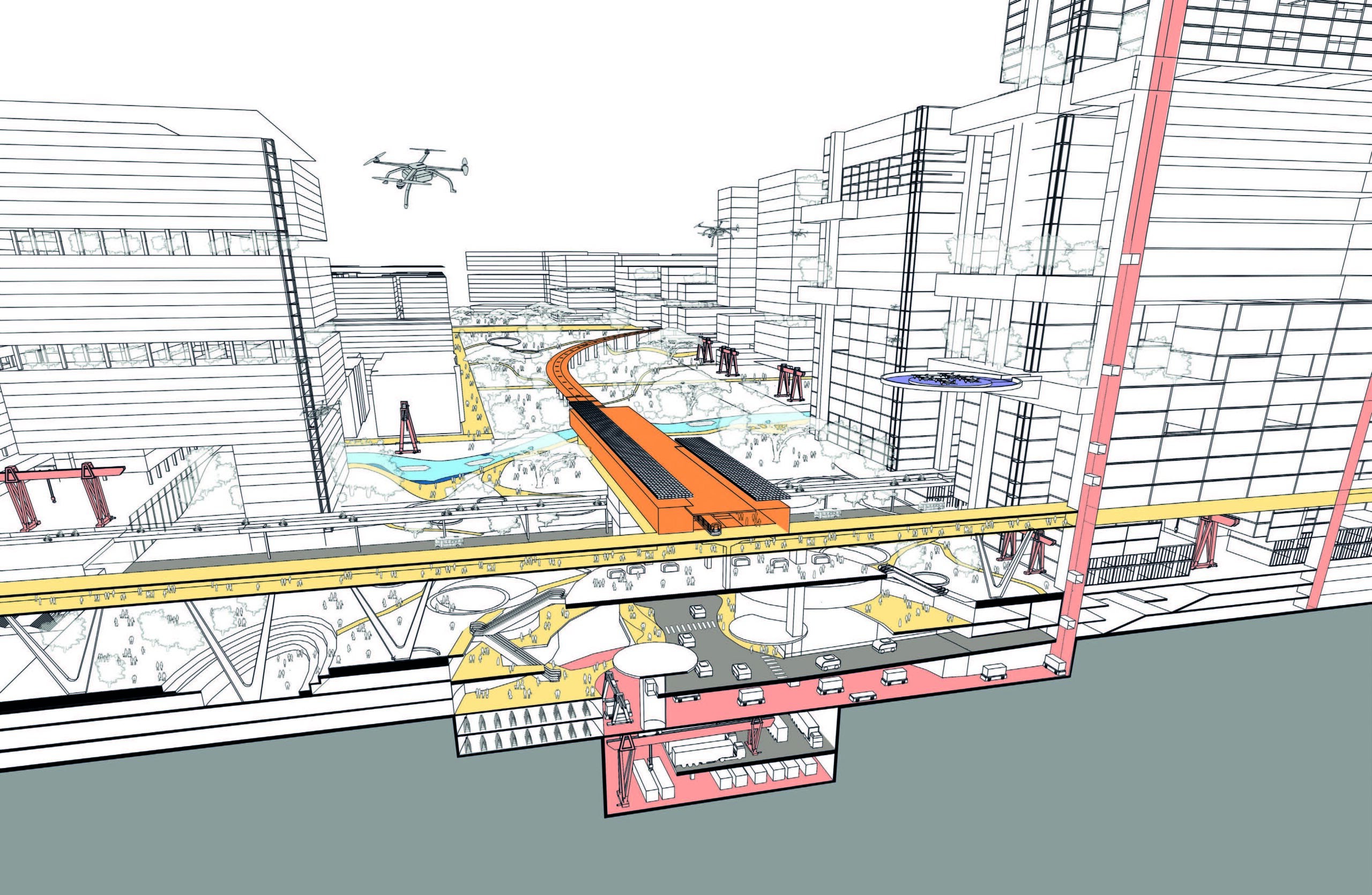
| JTC sought new approaches to the future masterplan for Sungei Kadut, an ageing industrial estate in Singapore, towards ambitions for circularity, land-use and urban quality. In collaboration with WOHA Architects, the Design Lab conducted a series of design-research studios that examined how resource flows shape urban systems. The studios developed both a strategic position and design proposals for the precinct. The research was consolidated and published as a book – Form Intelligence – Reimagining the Industrial Landscape for a Circular Economy. |
The ISD Carbon Calculator
The greatest opportunity to reduce whole-life carbon (WLC) lies at the earliest stages of design, while building form is still evolving. Yet most carbon assessment tools require information unavailable at this stage, limiting their ability to shape design.
The Design Lab developed the ISD Carbon Calculator to address this gap. The tool puts architectural form at the centre of carbon assessment, using only floor and envelope areas derived from early-stage massing models to estimate WLC.
The tool operates within the MSc ISD’s teaching-research ecosystem. Its use in the courses supports learning objectives and simultaneously creates a feedback loop that shapes its development for industry.
Doctoral Research
| Alakesh Dutta
His research examines the Food–Energy–Water (FEW) nexus through the question of urban resource autonomy. Cities consume far more resources than their territorial footprint can produce, creating dependencies that increase ecological impacts and exposure to external shocks. His work challenges this prevailing model by treating FEW production as a spatial design problem. It develops a multi-scalar, form-based approach that embeds resource-production capacity upstream into architectural and urban form. An integrated FEW algorithm models interdependencies between food, energy, and water systems, revealing synergies and trade-offs as competing resource priorities interact with decisions on density, land use, and urban morphology. Faizatuzzahrah Rahmaniah Zahrah is a PhD student in the Industrial Postgraduate Program at WOHA Architects, bringing together a BSc in Engineering Physics from Bandung Institute of Technology and an MSc in Architecture (Integrated Sustainable Design) from NUS. She is an architectural researcher working at the intersection of architecture, computation, and building performance, developing a computational framework for early-stage architectural design space exploration. Her research investigates how performance can become part of the design process from the outset, not simply as a means of assessing a design, but as an integral part of discovering and exploring what a design could become. Rather than replacing designer judgement, she explores how computational tools can reveal the complex relationships among spatial configurational decisions, architectural form, and building performance, thereby augmenting designer decision-making and opening new possibilities for architectural form-making. |
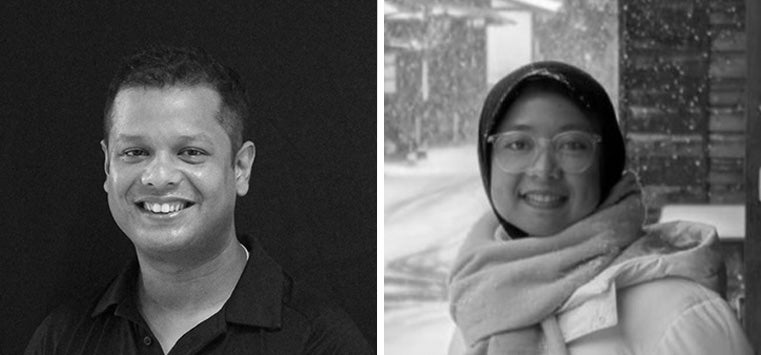
From left to right: Alakesh Dutta and Faizatuzzahrah Rahmaniah
People
Alakesh is a Research Associate and PhD student at the National University of Singapore (NUS). He leads several ISD research initiatives, including the development of the ISD Carbon Calculator and a range of funded research projects. His research focuses on regenerative and systems-based approaches to architecture, with particular interest in food-energy-water autonomy and the relationship between resource systems and urban form. He also contributes to ISD teaching, creating a direct bridge between the programme’s research and studio-based design pedagogy.
Bridging academia and practice, Alakesh brings over 15 years of experience across leading firms and institutions in India, the US and Singapore. His work includes Singapore’s first net-zero energy building, SDE4, and the Vertical Fish Farm.
Andrei is a graduate of the MSc Integrated Sustainable Design programme and a licensed architect in the Philippines with project experience at both the building and urban scales. He is also the chief design officer of RADIC, a Philippine-based non-government organisation that advocates for human-centred participatory design and social impact. His research interests include self-sufficient building typologies and communities, and the relationship between policies and the built environment.
Sheu Wen’s research lies at the intersection between computation, sustainability and design. She holds concurrent Master’s and Bachelor’s degrees in Architecture from NUS (2025). Her recent projects include applying machine learning to climate-aware point clouds at the Creative Data Critical Design Lab in NUS, as well as creating web tools for educational purposes, analytical geometry, and urban design. Currently, she is adapting ISD’s pedagogy into digital design tools used for live studio instruction, such as an urban-systems mapping tool and a carbon calculator for guiding early-stage architectural design.
Hao Yuan holds concurrent Master’s and Bachelor’s degrees in Architecture from NUS (2026), where he did his thesis on Human-Computer collaborative design. He has had experience in R&D for commercial robotic fabrication in 3D concrete printing in Singapore, and has been instrumental in developing an integrated 3D interface for ISD’s Carbon Calculator using Rhino and Grasshopper scripting. This allows for real-time whole-life carbon projections from only massing models. He is fascinated by all things computational in architecture and design!