Master of Science, Integrated Sustainable Design
The Pedagogy
The programme is anchored to three knowledge pillars: Systems Thinking, Form Intelligence, Story of Place.
| Systems Thinking is where you start. Before you can design anything, you have to see what’s there: the networks of energy, water, food, mobility, public space and ecology that a site is situated within. Mapping systems lets us observe the flows and exchanges that connect what a building does to how urban systems operate, how a city is planned to how ecological systems evolve. And it treats time itself as a variable — asking how what’s built today holds up under conditions that haven’t happened yet.” Read more on systems thinking in this paper.
Form Intelligence is where you act on what you’ve mapped. What if form decisions – such as geometry, porosity, connectivity, topology – set out to intentionally create positive systemic health? How would you shape a building if, say, the goal were to be a net producer of energy? What if a building were also a habitat for flora and fauna? Story of Place is where you ask why the same system produces different outcomes in different places. Human experience of biophysical systems is shaped by history, culture and climate. The mapping of place keeps systems thinking from becoming an abstraction: it ties everything back to a lived situation. |
The MSc ISD studios (ISD5101 and ISD5102) are where these pillars are taught, not as three topics but as a single progression: Literacy → Integration → Agency.
| Literacy: short assignments that build fluency in each of the three pillars.
Integration: apply all three at once, map and analyse a real, complex, multisystemic site. Agency: apply what you’ve learnt to two contexts – Singapore and one other Asian city – and say where and how you will restore, repair, regenerate.
|
The Lenses
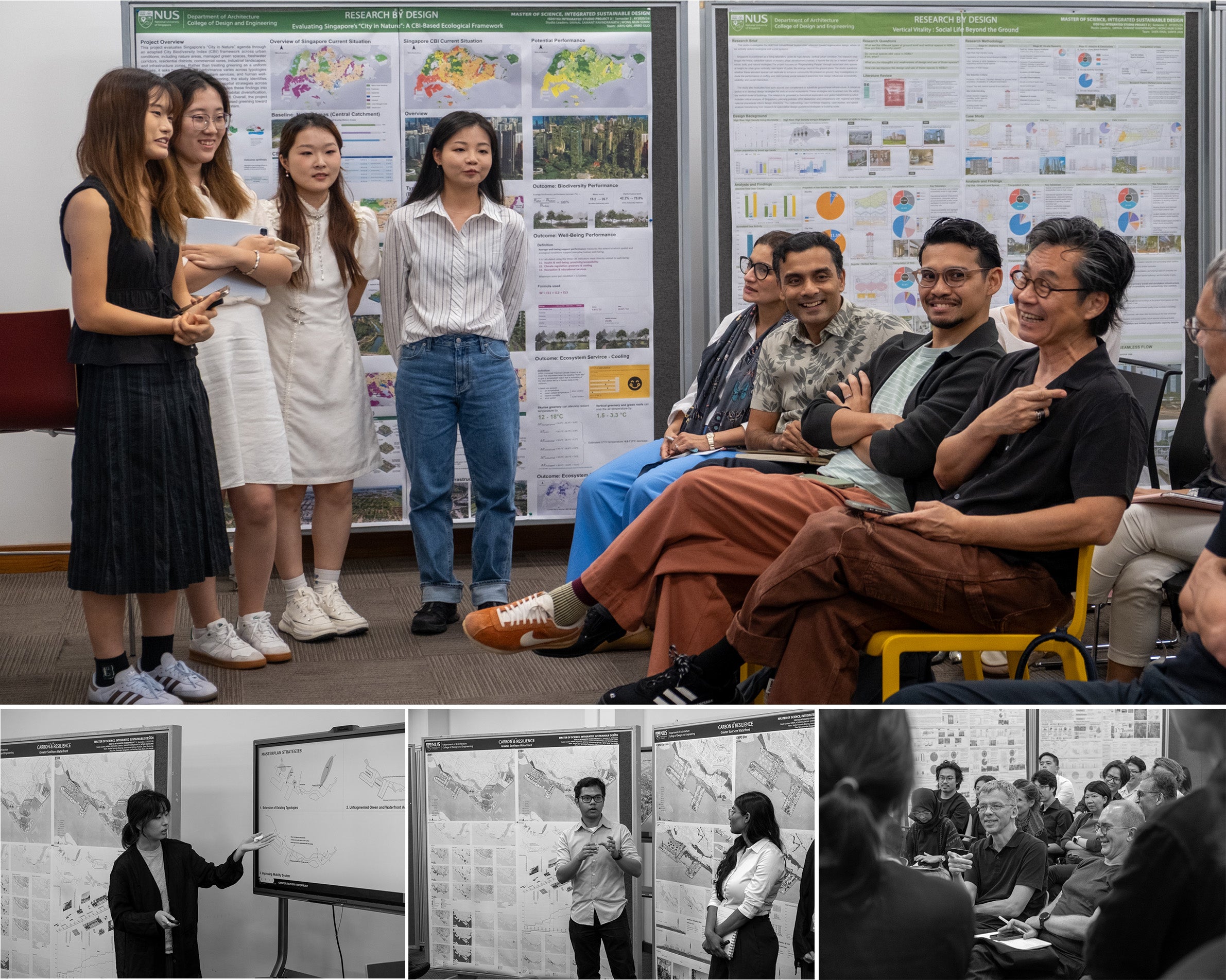
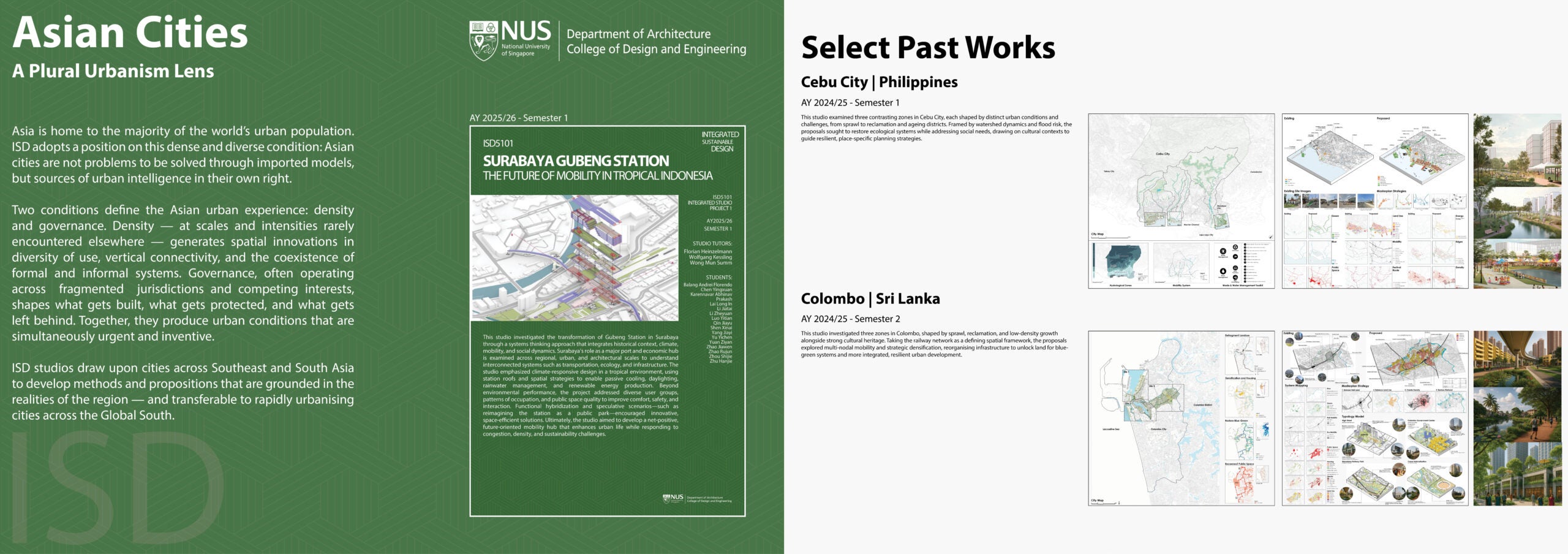
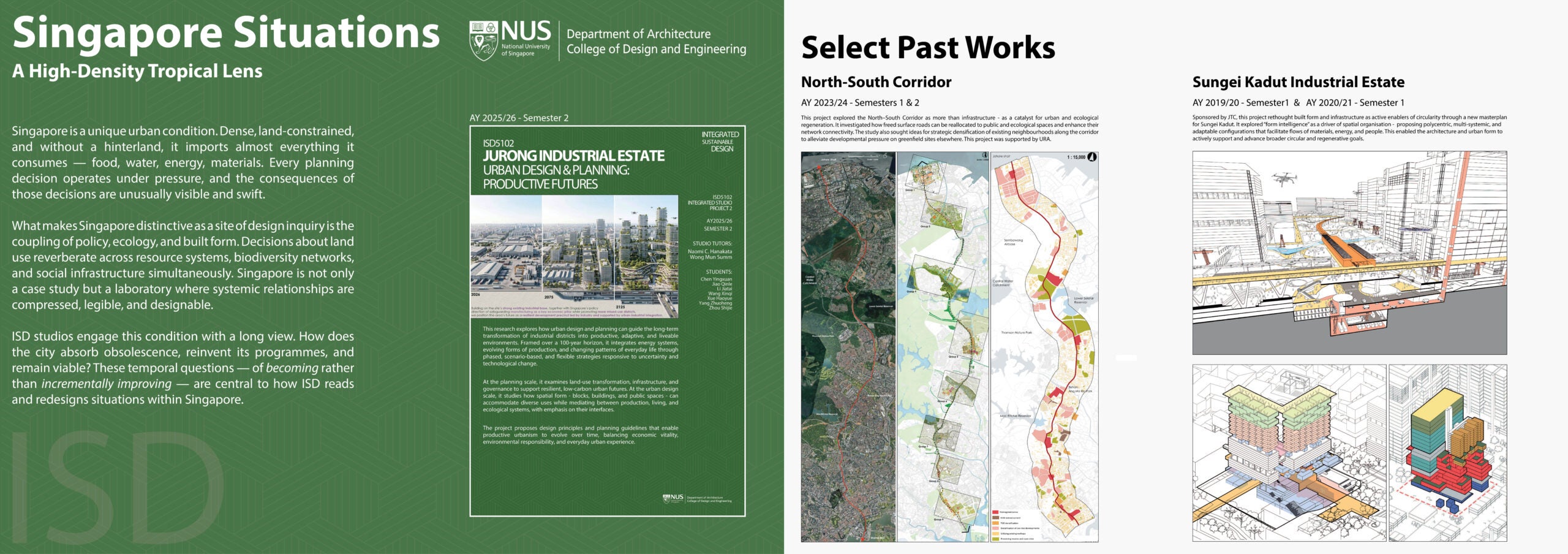
Each year, the studios tackle two or more specific themes. From the briefs offered, you can choose one that matches your interest.
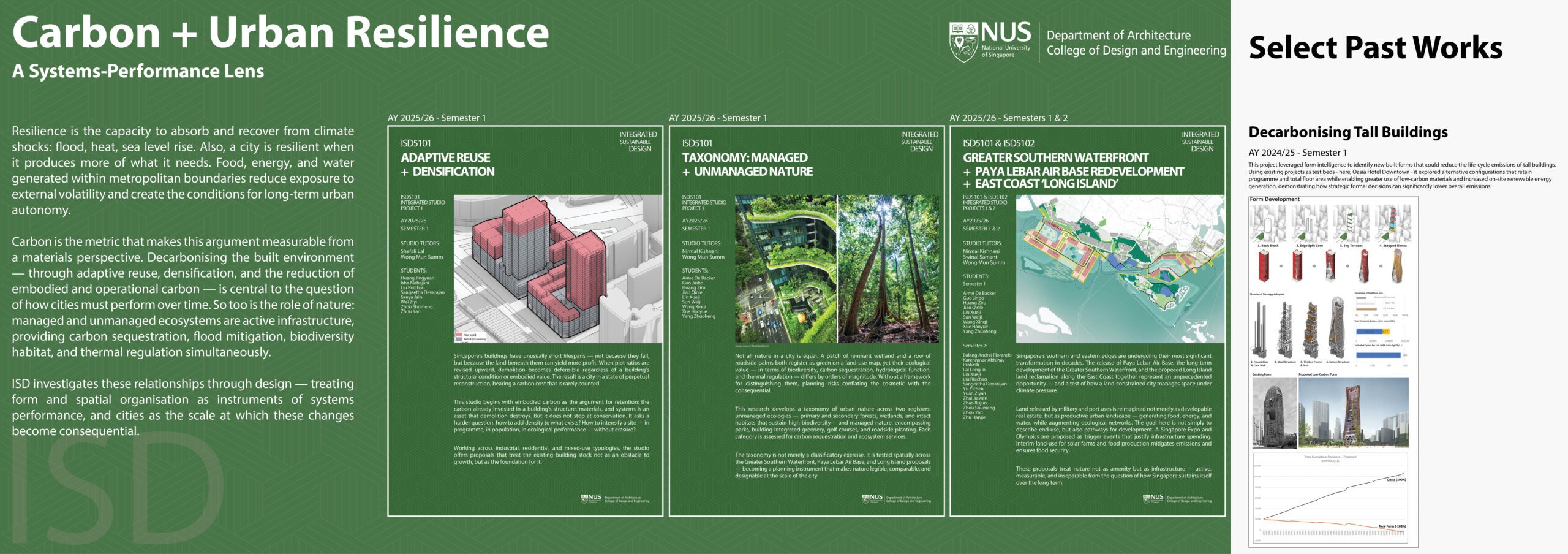
Carbon and urban resilience: how buildings and cities decarbonise, and how they absorb shocks like flood, heat and sea-level rise, using nature itself as active infrastructure.
|
Courses
Students pursue a two-semester progression of coursework:
ISD5101: Integrated Project Studio 1 (8 Units)
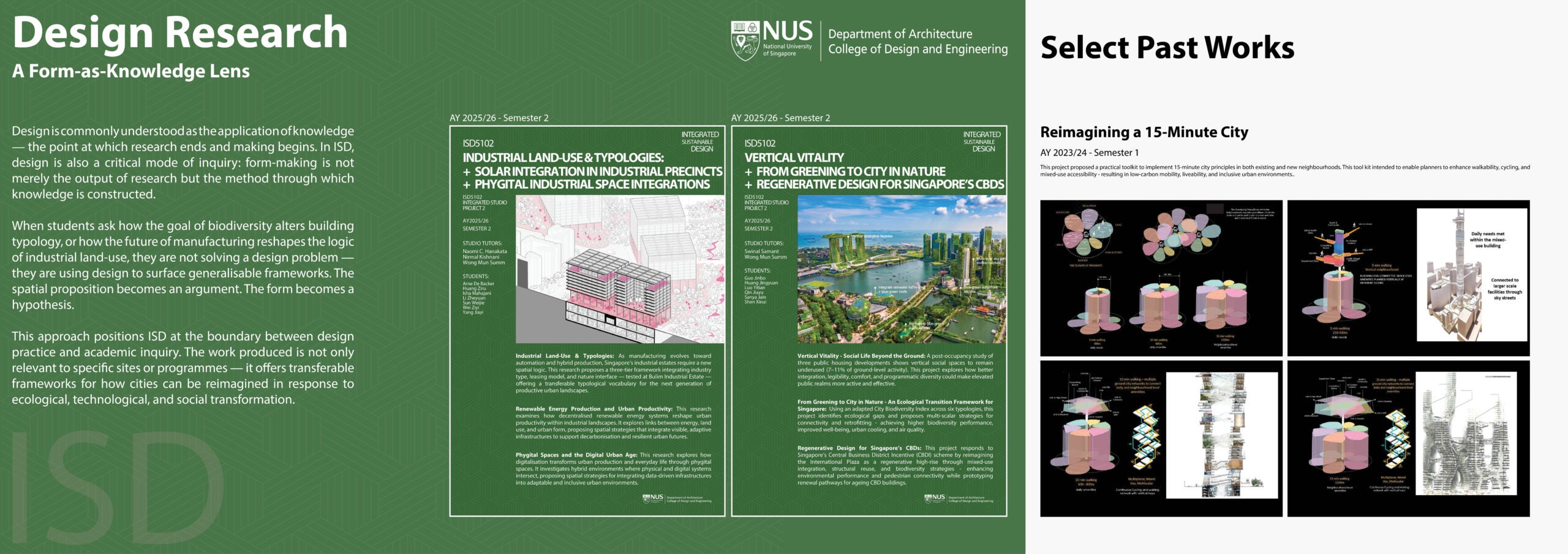
ISD5101 introduces the foundational ideas and methods that underpin the programme’s approach to design. A series of focused mini studios develops capabilities in systems thinking, form intelligence and story of place, followed by integrative systems mapping and network analysis. Students learn to visualise complex systems, boundary conditions, and transformations. The course builds the conceptual and methodological agility needed to engage with more complex, site-specific challenges in semester 2.
ISD5103: From Green to Regenerative: Shifting Paradigms in Design and Urbanism (4 Units)
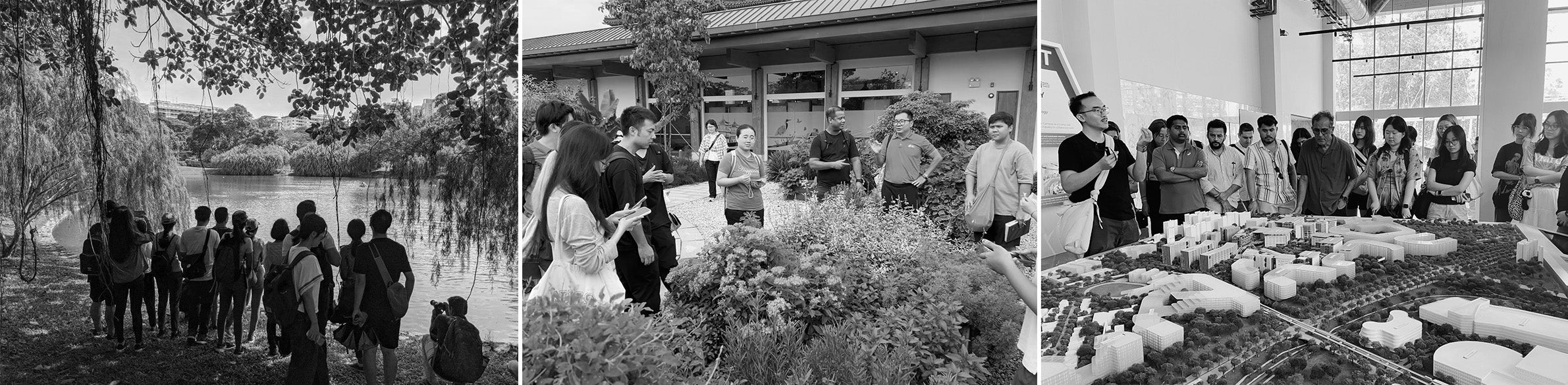
ISD5103 offers a critique of the green movement, seeking to differentiate the reductivism of checklists from more holistic outcomes. It begins with the bioclimatic traditions of the tropics, where form was the primary environmental instrument, and traces how the rise of rating tools narrowed this into an optimisation of parts. It then pivots to emerging ideas on regenerative design, which makes a case for the repair and reintegration of human-made and natural systems. Students visit landmark projects in Singapore and hear from frontline practitioners. They enter a conversation on the green–sustainable–regenerative continuum at two scales: first through direct observation of buildings, then at city scale, examining regenerative urbanism and the conditions that enable or constrain it.
ISD5104: Energy & Carbon (4 Units)
Reducing energy consumption is only part of the response needed to address global warming. For a comprehensive response, carbon must be understood across the built environment, from materials and buildings to neighbourhoods and cities. ISD5104 positions energy within interacting systems – including ecology, mobility, water, materials, governance and social equity – that collectively shape carbon performance. Carbon is understood as a design driver operating across scales and systems. Sessions connect carbon accounting with ecology, form intelligence, urban infrastructure, governance and social equity. Teaching combines practice-based case studies with data-driven tools, notably the ISD Carbon Calculator and others such as the Carbon Cost Calculator
ISD5106: Bio-Centric Design for the Built Environment (4 Units)
ISD5106 looks at various facets of urban design with nature at its core – designing the built environment with nature, for nature and as nature within context and socio-ecological limits. The course will discuss the multi-faceted nature of ecological design by addressing questions of scale on land and water, ground to sky and urban to rural. Various approaches from nature-based solutions to biomimicry are discussed. Highlights include understanding what type of nature thrives in cities, what is its global, regional and local value; and what are the processes behind it (urban soils, waterways and carbon), valuation frameworks (biodiversity net gain, ecosystem services, human well-being) and finally which policy decisions drive such efforts.
ISD5102: Integrated Project Studio 2 (8 Units)
ISD5102 builds on the foundational knowledge and methods introduced in ISD5101, applying them to complex, real-world design challenges. As a full-semester project, students work with specific sites and briefs that cover building, network or city scales, translating lessons learnt into actionable ideas. Through this process, students develop the strategic judgement needed to negotiate complexity, trade-offs and real-world constraints.
ISD5105: Principles of Sustainable Urbanism (4 Units)
The accelerated, often rampant, growth of cities in Asia alters the quality of their inhabitants’ lives, their ecological footprints and community bonds. Coping with urban growth affects not only those in the city; it also affects also those in agricultural belts in rural peri-urban areas which are increasingly threatened by urban sprawl. ISD5105 investigates various historical and economic forces shaping urban developments, identifies the elements of urbanism that have a direct impact on the environment (such as transport infrastructure) and offers insights into how sustainability principles can lead to new paradigms for urban rejuvenation and growth.
ISD5107: Planning Urban Food Systems (4 Units)
ISD5107 focuses on urban food systems and discusses their multiple aspects, including the history of the relation between cities and food, the types of urban farming systems, and the relation to other biophysical systems, particularly energy and water. This course elaborates on the design and planning aspects of urban food systems and their possible spatial forms within high-density cities where space availability is constrained, and demand for food is concentrated.
Free Elective: (4 Units)
Students can choose an elective from a list of courses offered by the Department. This will be communicated to students prior to the start of the semester.
ISD5101 (semester 1) and ISD5102 (semester 2) run two afternoons a week. Studio assignments are organised into group work, with part of the final grade tied to an individual’s role, effort and leadership within the group.
All courses are taught during the day. Some courses (excluding ISD5101 and ISD5102) may be front-loaded into 1 to 2 weeks at the start of the semester or compressed into 5 to 6 weeks. The detailed schedule of classes for each semester will be released a couple of months ahead for part-time students to plan their calendar.
Notes to Part-Time Students:
Part-time students complete the programme over four semesters (two years). They are required to take courses in a prescribed sequence.
In semesters 1 and 2, part-timers must complete all courses (excluding ISD5101 and ISD5102). For this, they may need to arrange time-off with their employers
In semesters 3 and 4, they must complete ISD5101 and ISD5102. If necessary, consultation slots can be scheduled after office hours, once or twice a week, for meetings between student and tutor.
Part-time students may contact the Programme Director one month prior to the start of a semester to request the finalised schedule.
Candidature
To be awarded the degree, a candidate must attain 40 Units made up of the following:
• 2 Integrated Project Studio Courses (8 Units each = 16 Units)
• 5 Lecture Courses (4 Units each = 20 Units)
• 1 Elective (4 Units each = 4 Units)
| Degree Requirements | 40 Units | |
| Candidature | Full-time | minimum 1 year – maximum 2 years |
| Part-time | minimum 2 years – maximum 4 years | |
| Continuation Requirements | https://cde.nus.edu.sg/graduate/graduate-programmes-by-coursework/graduation-requirements/ | |
| Graduation Requirements | A student pursuing a Master’s degree by coursework must achieve a minimum Grade Point Average (GPA) of 3.0 to be eligible for graduation. | |
Other Learning Opportunities
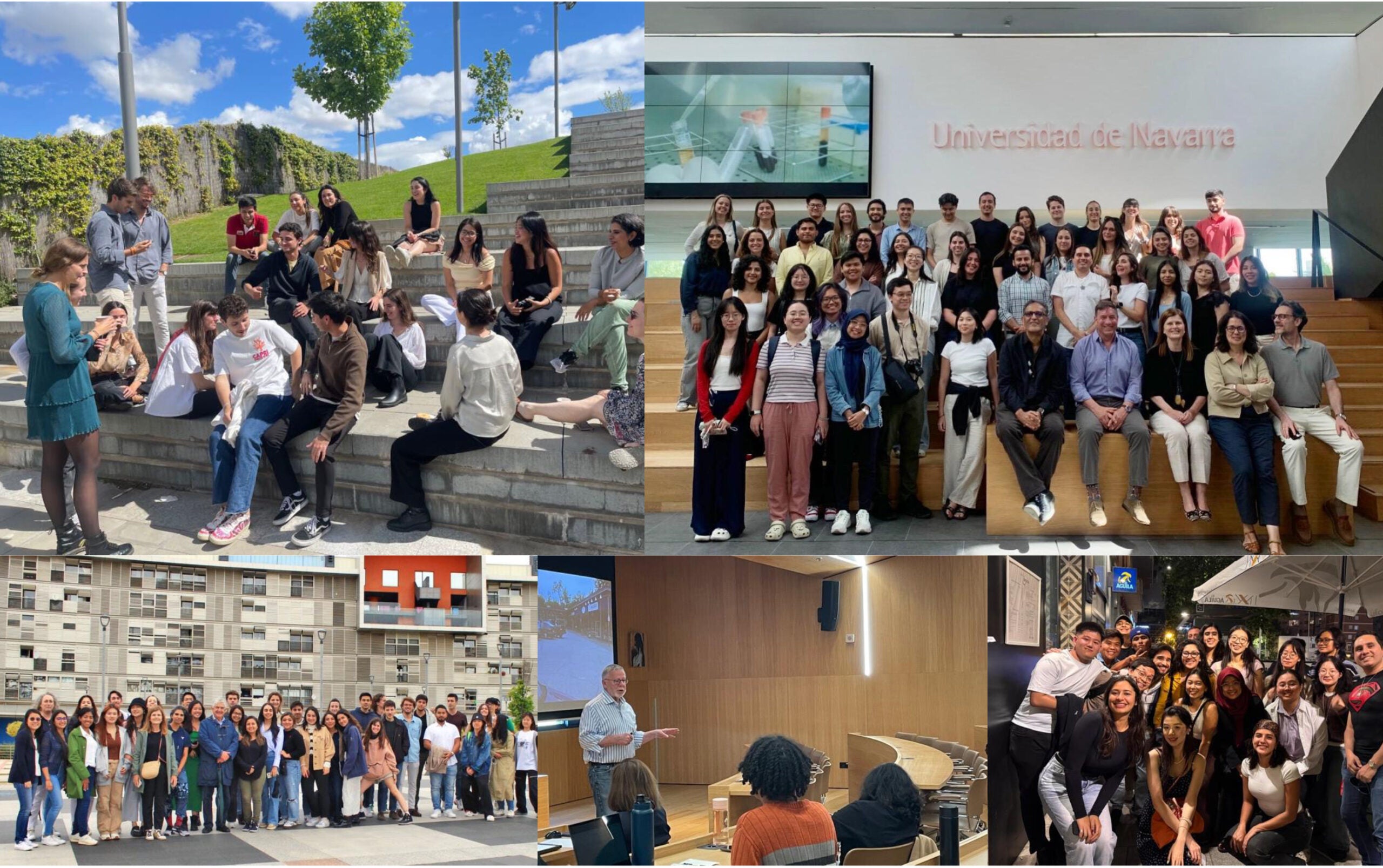
The annual Regenerative Design Workshop, conducted in collaboration with the University of Navarra (UNAV) in Madrid, Spain, is a highlight of the MSc ISD calendar. It introduces students to some of the world’s most respected voices in sustainability and regenerative design. Held annually in the first week of June, the workshop is anchored by renowned experts. Past editions have been led by Chrisna du Plessis (2023), Bill Reed (2024), and Bill Browning (2025 & 2026). Each week-long programme combines sessions with these experts and curated site visits in Madrid. Participation in these workshops is optional. There are no fees for the workshop; however, the cost of travel and accommodation is self-financed by participating students.
Enquiries
Submit your enquiry through this web form. From the drop-down menu , select Department of Architecture followed by Master of Science, Integrated Sustainable Design.
Alternatively, you can email the MSc ISD Programme Director.
Apply Now
Apply now to the Master of Science in Integrated Sustainable Design.