MESSAGE FROM THE DEAN!
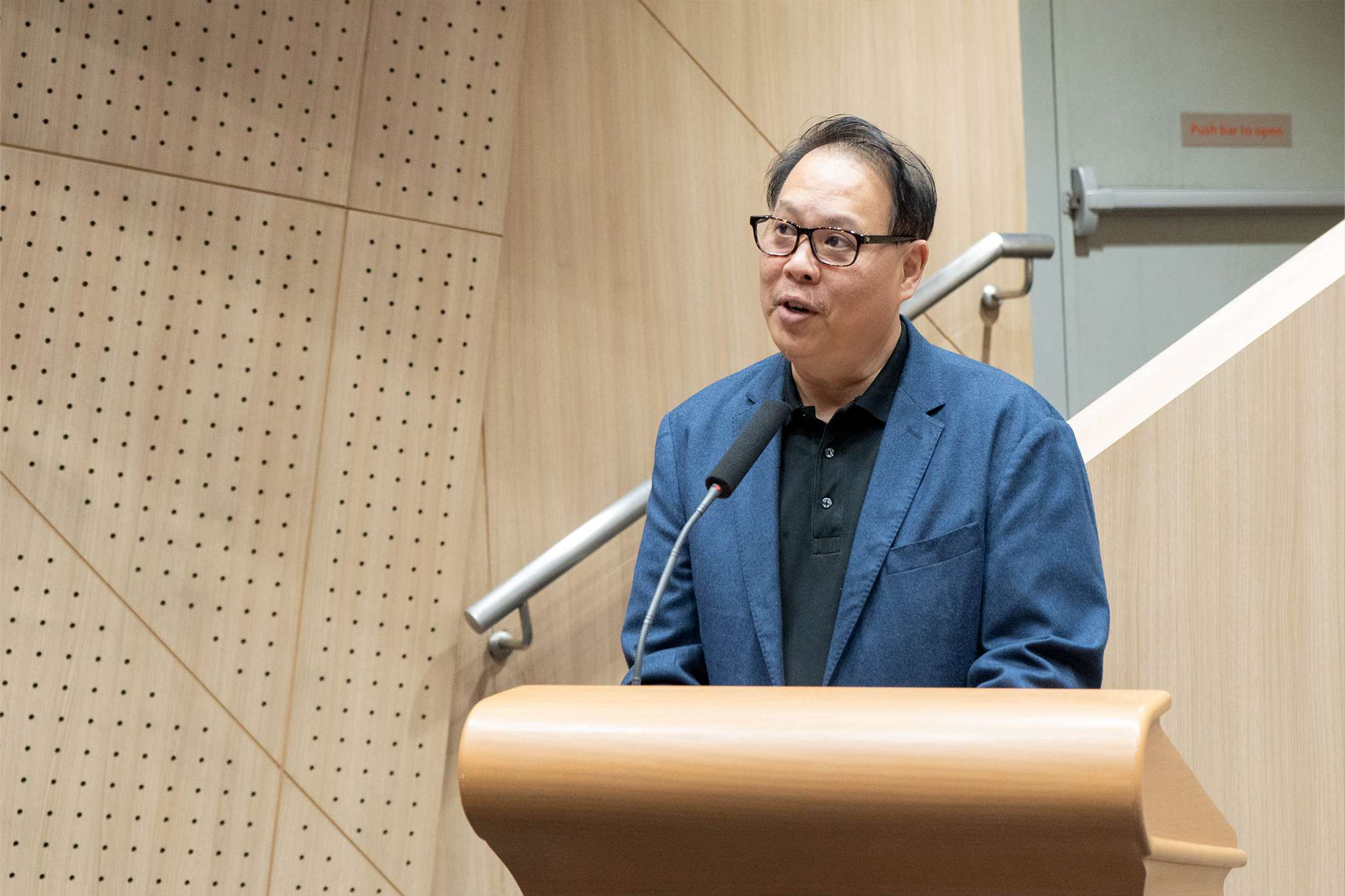
Dear students, alumni, colleagues, and partners of CDE,
This past month, you might have seen articles and posts about the 2024 Singapore winner of the James Dyson Award—Luke Goh, Industrial Design (Class of 2024). Luke’s thesis project, Mammosense, is a first-of-its-kind tool that analyses individuals’ breasts to determine the optimal compression force required during screenings for greater patient comfort and encourage increased participation in cancer screenings. This is the 3rd consecutive win for the Division of Industrial Design – certainly a high point!
His work is intriguing because this young man had no qualms about embarking on this project—addressing a problem that would seem remote to the male population! Instead, his observations from his mother’s own experience drove his research, and intent in understanding the real problem underwent a mammogram himself. That is the spirit I often see in our College—the inquiring mind coupled with the drive to improve the lot of others.
The month was capped by another top achievement – former Head of Department of Chemical and Biomolecular Engineering Professor Liu Bin was awarded one of the nation’s highest honours – the President’s Science Award. Among her scientific achievements, she was also recognised for her creative and entrepreneurial mindset.
The inquiring mind, the interest in learning new things, and the love of exploring and experimentation – should always be encouraged here at CDE.
Professor Teo Kie Leong
Dean
College of Design and Engineering (CDE)
HIGHLIGHTS
EVENTS
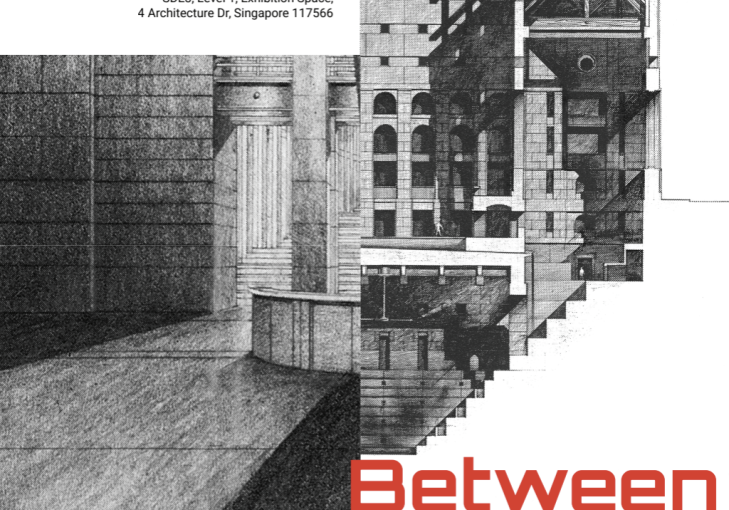
Between Line & Form Exhibition
Between Line & Form is an exhibition of hand-drawn architectural sketches by Ar. Rene Tan, presented in conjunction with the RT+Q Drawing Prize at NUS. Spanning over 40 years, the showcase features lead-on-paper sketches, mechanical pencil on vellum, ink and Pantone on Mylar, pen parti diagrams, ballpoint design esquisses, and sketchbooks on loan from the National Archives of Singapore. These drawings trace a personal journey through observation, discovery, improvisation, and speculation. From “Covid Drawings” exploring interior space to “Otto Wagner Drawings” on proportion and detail, “Pantone Drawings” on light and shadow, “Travel Sketches” on place and memory, and “Sketchbook Etudes” tracking design ideas, each work embodies what Michael Graves called “tangible speculations.” Between Line & Form invites visitors to reflect on the enduring value of hand sketching in an increasingly digital design culture, and to appreciate the liberating journey between each line and the next.
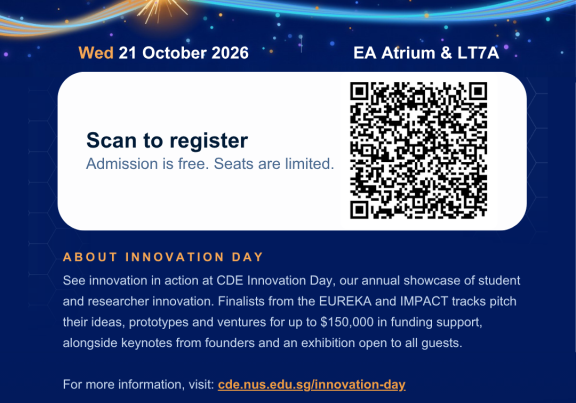
CDE Innovation Day 2026
CDE Innovation Day 2026 gives NUS students and researchers a clear pathway to develop ideas, strengthen prototypes and turn research into real-world solutions through three tailored tracks. Bringing together design, engineering and enterprise, the programme helps participants build skills, test and refine their concepts, and compete for more than SGD 300,000 in funding at the […]
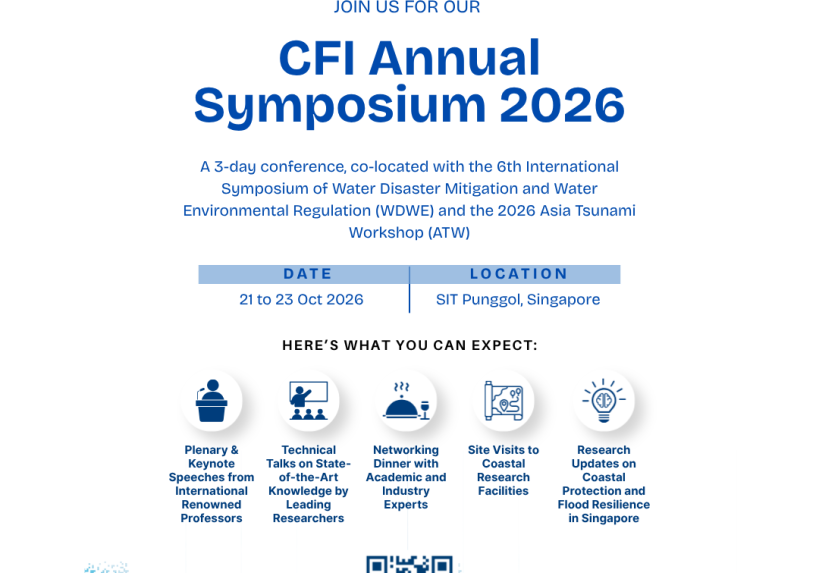
Coastal Protection and Flood Resilience Institute (CFI) Annual Symposium 2026
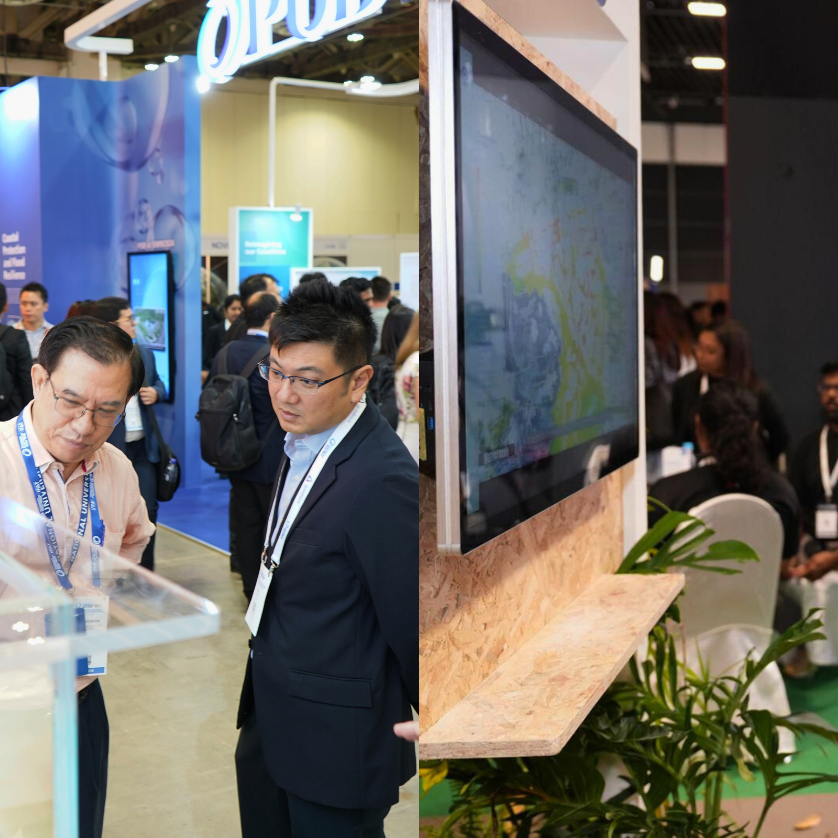
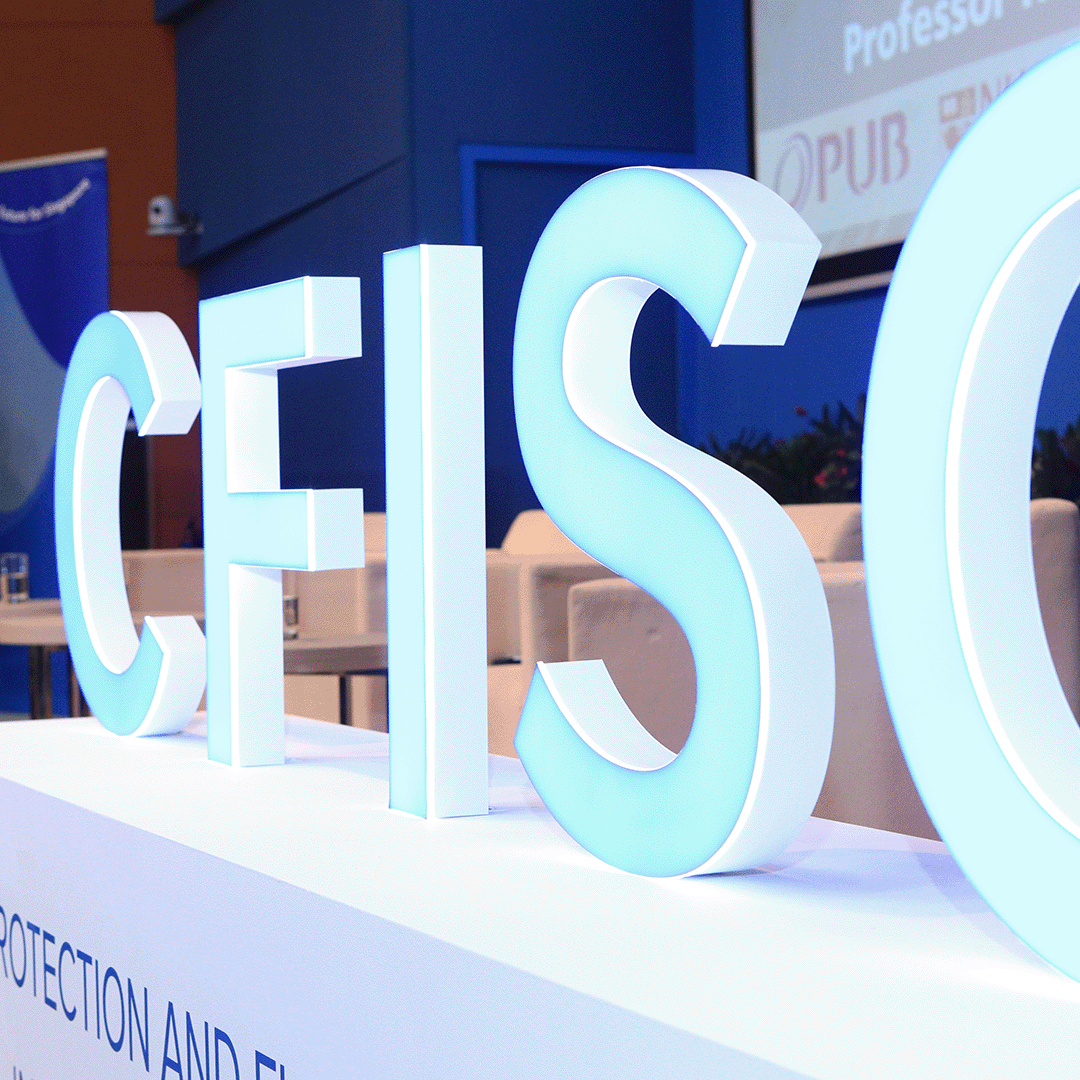
The CFI Annual Symposium 2026 is a 3-day conference, co-located with the 6th International Symposium of Water Disaster Mitigation and Water Environmental Regulation (WDWE) and the 2026 Asia Tsunami Workshop (ATW), which would be held at SIT Punggol from 21st October to 23rd October. The theme for this year’s CFI Annual Symposium 2026 is ‘Adapting Cities for Coastal and Flood Resilience’, reflecting the urgent need to take proactive steps to prepare for flooding in our cities. Admission is free for all CFI Symposium attendees. Paid tickets are also available for WDWE and ATW.
PREVIOUS ISSUES