

D-Tech Studio: Autonomous Farming Systems
D-Tech Studio designs the structures and automation that let vertical farms run with far less manual work. Transplanting, harvesting, inspecting and pruning are still largely done by hand, in racks and trays rarely designed with robots in mind.
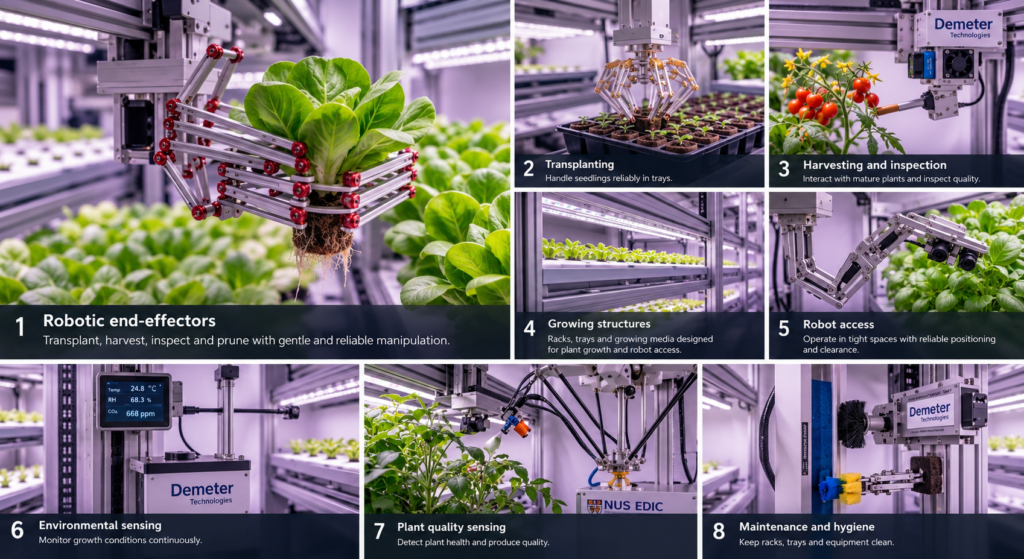
This iteration centres on mechanical design and actuation across three ranked areas: robotic end-effectors first, then structures for growing, then sensors and quality control. Sensing, control and plant science support that work, and every design is tested with live plants on a rack section.
Problem statements:
Three design areas, ranked by priority for this iteration:
| Tier | Problem statement | Core question |
| Primary | Robotic end-effectors | How can a robot transplant, harvest, inspect and prune plants as gently and reliably as a skilled worker? |
| Secondary | Structures for growing | How should racks, trays and growing media be redesigned so plants grow well and robots can work them? |
| Tertiary | Sensors and quality control | How can a farm measure plant health and produce quality continuously, and act on what it finds? |
Why this is a systems problem:
Most of the hard constraints on a farm robot come from outside it: fragile plants, tight tiers, varied trays, humidity and hygiene. The three areas are therefore designed together, and a tray or rack change that makes the robot's job easier counts as part of the solution.
Design focus and scope:
Mechanical design and actuation are the main deliverables in every tier; the supporting aspects are explored as far as they serve them.
| Tier | Problem statement | Main deliverables | Supporting aspects |
| Primary | Robotic end-effectors | Digits, joints, kinematics, actuation and the interface to the arm or gantry, for transplanting, harvesting, inspecting and pruning | Tactile and force sensing, grasp control, plant tissue limits |
| Secondary | Structures for growing | Racks, trays, channels and growing media designed for plant growth and robot access | Irrigation, lighting and airflow, integration, hygiene |
| Tertiary | Sensors and quality control | Mounts, enclosures and positioning mechanisms that bring sensors to the plant | Plant health monitoring, produce grading, data and alerts |
Deliverables:
Working prototypes, tested on live plants at a rack section, developed in six stages:
- Task study: document plant, tray and rack constraints at a farm or the lab rack.
- Requirements: set measurable targets, such as grip force limits, clearance and cycle time.
- Concepts: generate and compare mechanical and actuation concepts.
- Prototype: build and iterate.
- Rack testing: test on live plants against the requirements.
- Showcase: present the solution, test results and a design package (CAD, code, bill of materials).
Who should join:
Any major is welcome. Students from Mechanical Engineering, Electrical Engineering, Computer Engineering, Biomedical Engineering, and Computer Science help the work move fastest. Life Sciences, Food Science and Technology, Civil Engineering, Architecture, Industrial Design, Industrial and Systems Engineering, Materials Science and Engineering, Data Science and Analytics, and Business make the outcome richer.
Project partner:
- Arianetech Pte Ltd
Project supervisors:
- Dr Aleksandar Kostadinov (aleks_id@nus.edu.sg)
- Mr Soh Eng Keng (ek.soh@nus.edu.sg)
Studio timeslot in Semester 2 AY2026/2027:
- Wednesday 9 am to 12 pm
Past projects

Automated transplanting system for hydroponics
To transplant germinated seedlings from a germination tray to a larger growing tray.
Student disciplines: Civil Engineering, Computer Engineering, Electrical Engineering, Industrial & Systems Engineering, Life Sciences

Open source IoT farming system
To automate processes, provide real-time data, and optimize resource usage for precision farming and enhanced crop growth.
Student disciplines: Chemical Engineering, Electrical Engineering, Mechanical Engineering

Optical sensor for precision agriculture
Low-cost real-time optical sensor with an integrated filter to prevent cyanobacteria growth in indoor duckweed farms.
Student disciplines: Chemical Engineering, Computer Engineering, Life Sciences

Rotating vertical farm
A moving farm that redefines farming productivity in a confined space, improving crop yield by 2.5 times.
Student disciplines: Business, Computer Engineering, Engineering Science, Environmental Engineering