Kinetix
Stroke rehabilitation often requires patients to perform intensive and repetitive lower-limb exercises under the guidance of physiotherapists. However, manual physiotherapy can be physically demanding and difficult to scale, while existing rehabilitation devices may lack the integrated sensing needed to quantitatively track a patient's progress. Kinetix addresses these challenges with a technology-assisted rehabilitation system designed to support both patients and physiotherapists.
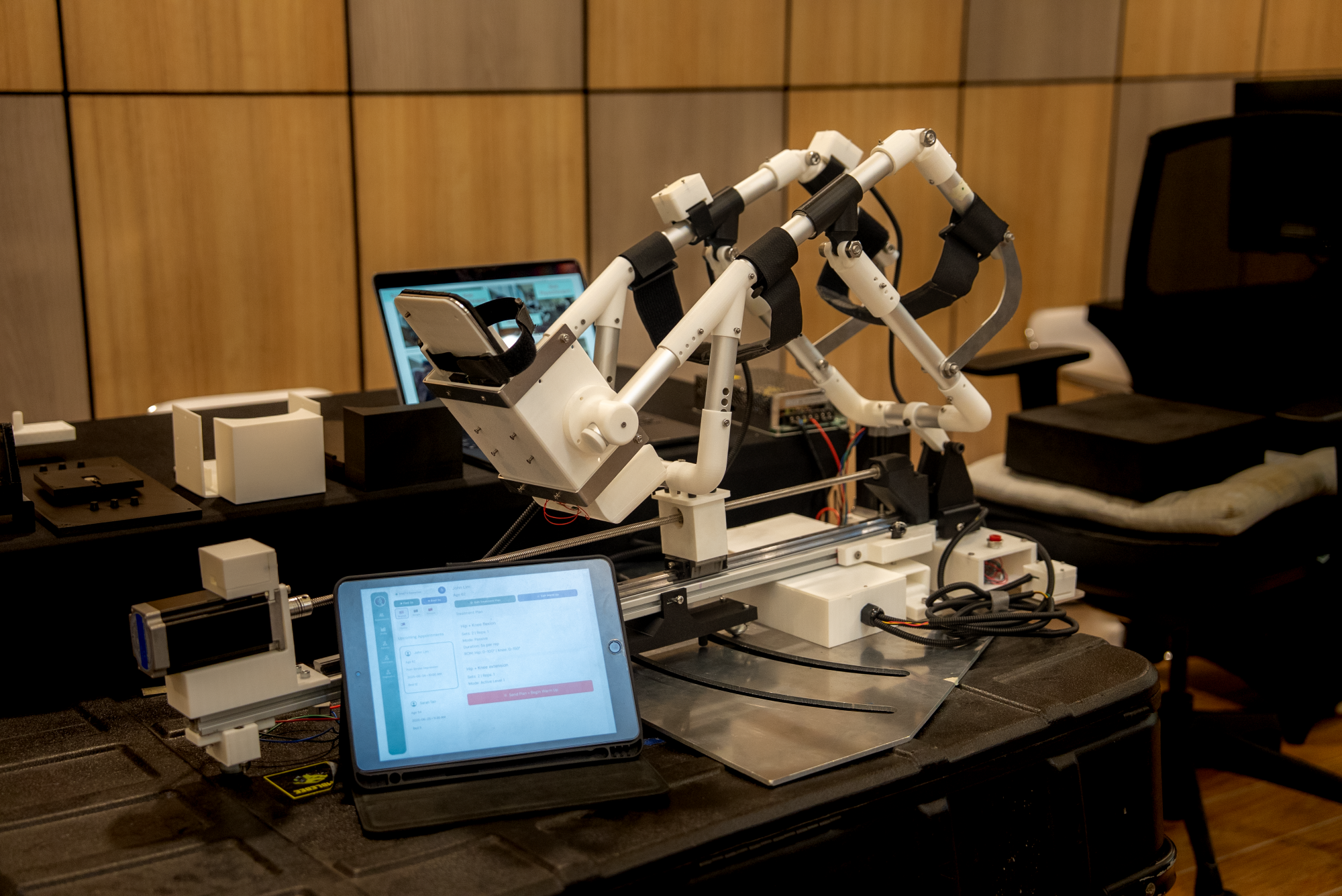
The device combines an adjustable aluminium rehabilitation frame with integrated motion and force sensing. IMU sensors measure joint angles while force sensors support six different exercises, enabling both passive and active rehabilitation. A Bluetooth-enabled app provides real-time force and angle tracking, while gamified feedback is incorporated to improve patient engagement and motivation during repetitive exercises.
Kinetix also supports a data-driven rehabilitation workflow in which physiotherapists can create treatment plans, monitor multiple patients and generate progress reports. Testing reported strong usability, setup and comfort ratings from both patients and physiotherapists. By combining rehabilitation engineering, sensing, digital monitoring and gamification, Kinetix demonstrates how technology could help physiotherapists manage more patients while providing measurable feedback to support each patient's rehabilitation journey.
Project Team
Students:
- Ahmad Rizqi Hidayat (Mechanical Engineering, Class of 2026)
- Nadia Rahman (Electrical Engineering, Class of 2026)
- Sebastian Mc Eon Espina Besonia (Electrical Engineering, Class of 2026)
- Tan De Xuan Ron (Biomedical Engineering, Class of 2026)
Supervisor:
- A/Prof Lim Li Hong Idris (lhi.lim@nus.edu.sg)