MEDetect: automated inspection of surgical tools
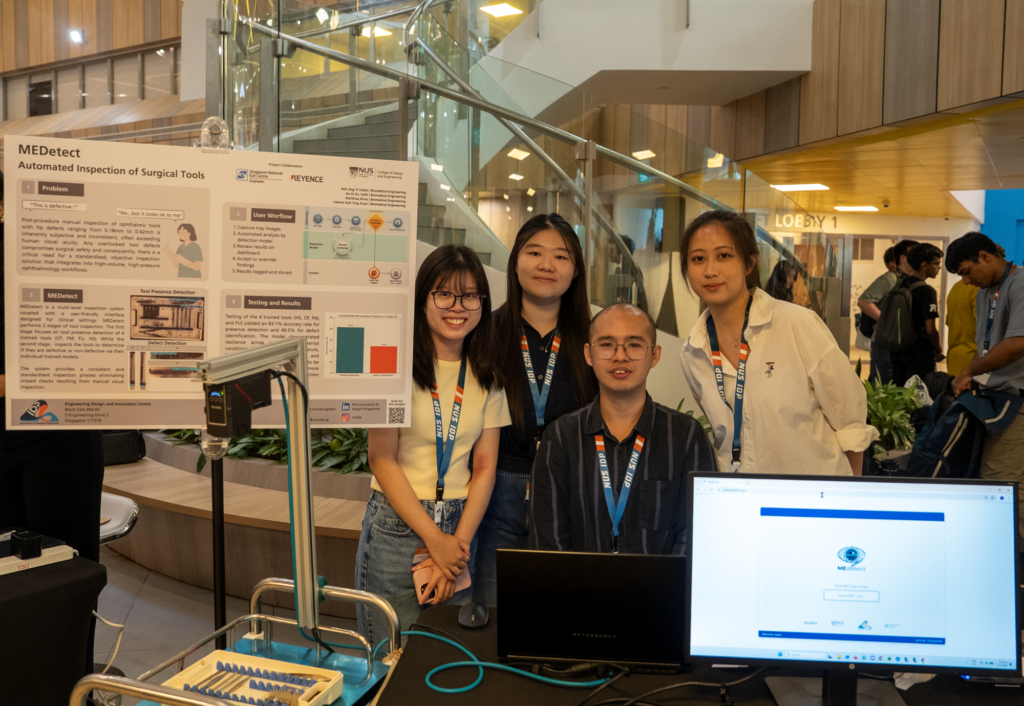
Following ophthalmic procedures, surgical tools must be carefully inspected for damage before they are reused. However, defects at the tool tip can be as small as 0.18–0.42 mm, making manual visual inspection subjective and potentially inconsistent. MEDetect addresses this challenge by providing a standardised, automated approach to inspecting ophthalmic surgical instruments.
Designed for clinical settings, MEDetect combines a multi-level computer vision inspection system with a user-friendly interface. The first stage checks whether four trained surgical tools are present, while the second uses individual models to classify each tool as defective or non-defective. The workflow allows clinical users to capture images of an instrument tray, review the automated analysis on a dashboard, accept or override the findings, and store the results for future reference.
Initial testing achieved 83.1% accuracy for tool presence detection and 49.5% for defect identification, with the models tested under variations in moisture, lighting, image resolution and tool placement. While further development is needed to improve defect identification, MEDetect demonstrates an early proof of concept for a more consistent, objective and clinically reliable surgical-tool inspection process, with the potential to reduce missed defects and support safer ophthalmic workflows.
Project Team
Students:
- Boh Jing Yi Celest (Biomedical Engineering, Class of 2026)
- Ho Di En, Faith (Biomedical Engineering, Class of 2026)
- Matthias Alexandar Khoo Kim Heng (Biomedical Engineering, Class of 2026)
- Valerie Koh Ying Xuan (Biomedical Engineering, Class of 2027)
Supervisor:
- Mr Nicholas Chew (nickchew@nus.edu.sg)