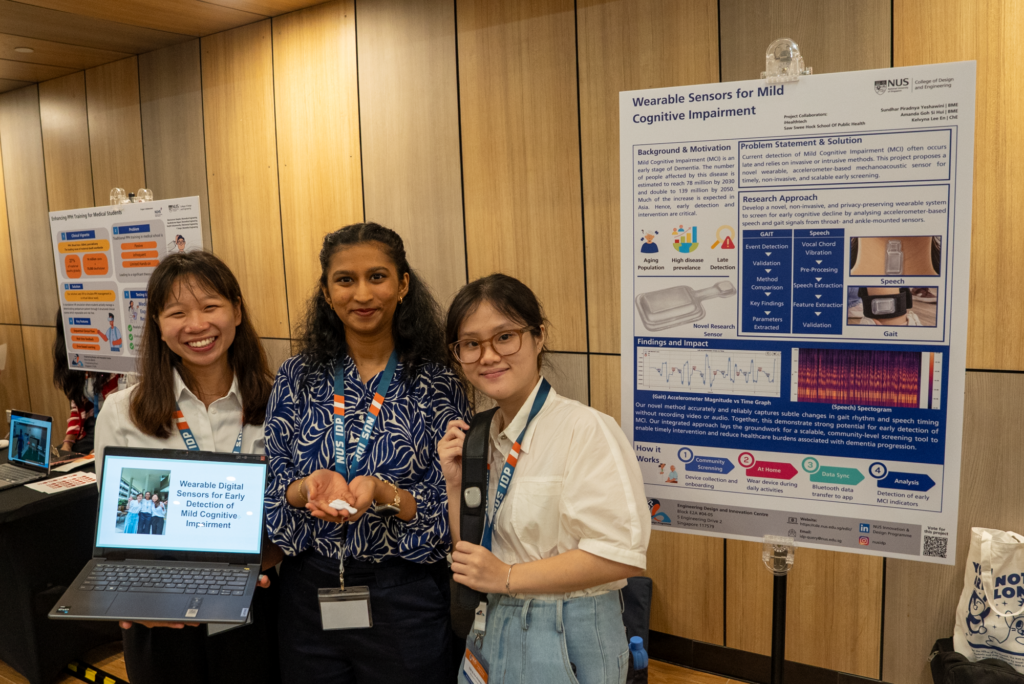

Wearable sensors for mild cognitive impairment

Mild Cognitive Impairment (MCI) is an early stage of dementia, yet detection often occurs late and can rely on intrusive assessment methods. This project explores a non-invasive, privacy-preserving wearable sensing system that could enable earlier and more scalable screening for subtle indicators of cognitive decline.
The system uses accelerometer-based mechanoacoustic sensors worn at the throat and ankle to capture speech and gait signals during everyday activities. Rather than recording video or audio, the sensors measure physical signals such as vocal-cord vibrations and gait movements. These data are processed to extract features related to speech timing and gait rhythm, providing potential indicators of early cognitive changes while preserving users' privacy.
Designed with community screening in mind, the proposed workflow allows users to wear the devices at home before transferring their data via Bluetooth for analysis. Initial findings show that the approach can reliably capture subtle changes in gait rhythm and speech timing, laying the groundwork for a scalable community-level screening tool that could support timely intervention and help reduce the healthcare burden associated with dementia progression.
Project Team
Students:
- Goh Si Hui Amanda (Biomedical Engineering, Class of 2026)
- Kelvyna Lee En (Chemical Engineering, Class of 2026)
- Sundhar Piradnya Yeshawini (Biomedical Engineering, Class of 2026)
Supervisors:
- Dr Yen Shih Cheng (sc.yen@nus.edu.sg)
- Dr Wu Changsheng (cwu@nus.edu.sg)