
Curriculum Structure
 Students should complete a total of 160 units (or the equivalent of 40 courses), comprising:
| Mechanical Engineering (ME) Undergraduate Curriculum Structure (Cohort AY2025/2026 onwards) |
|||
|---|---|---|---|
| ME Major Requirements | Common Curriculum Requirements | Unrestricted Elective (UE) Courses | |
Engineering Core (20 Units)
Mechanical Engineering Major
|
General Education (GE) Courses (24 Units)
|
Common Courses (16 Units)
|
40 units of Unrestricted Elective Courses
(Any course open to you; may be used to fulfil requirements for specialisations, majors or minors.) |
| Subtotal = 80 Units | Subtotal = 40 Units | Subtotal = 40 Units | |
| Minimum required for graduation = 160 Units | |||
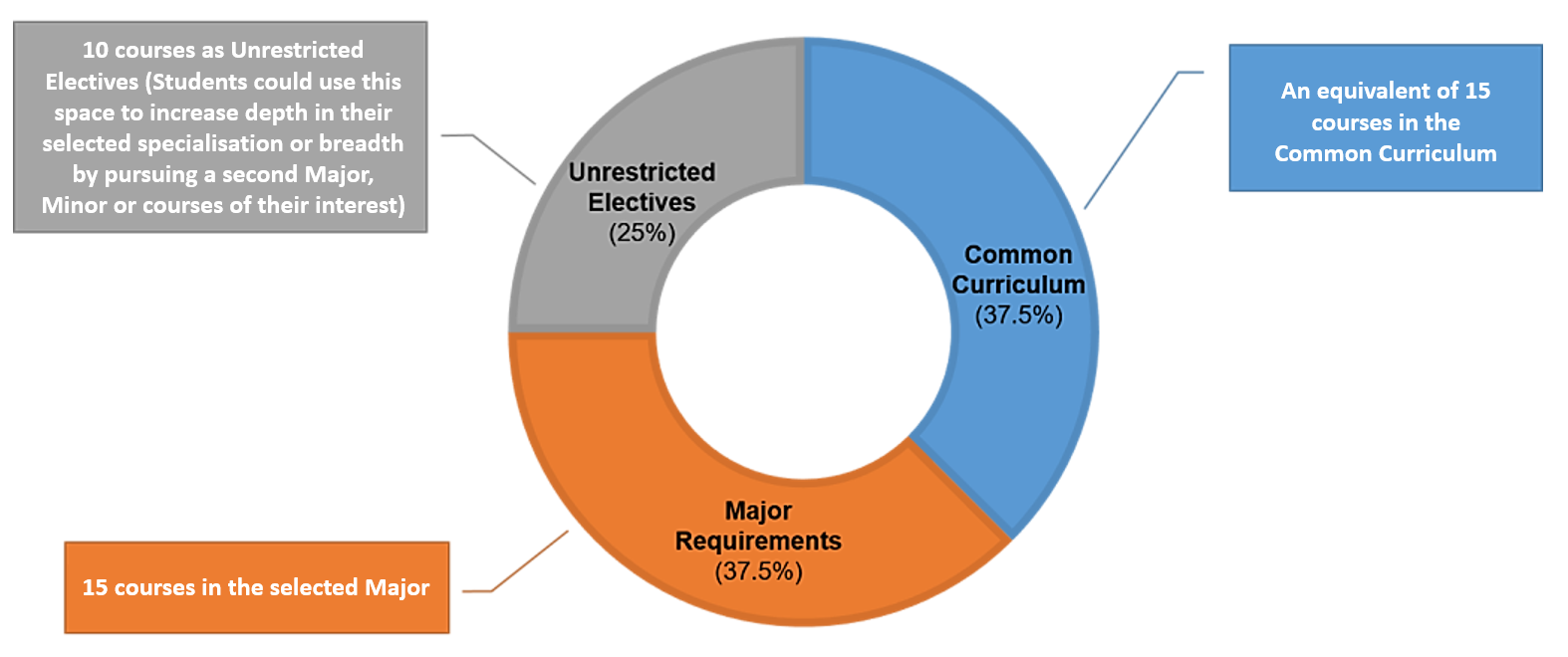
![Common Curriculum Modules[1]](https://cde.nus.edu.sg/me/wp-content/uploads/sites/11/2021/12/common-curriculum-modules1-1024x430.png)
Workload is measured in terms of Units, where one Unit is the equivalent of 2.5 hours of study and preparation per week. Most courses are typically 4 Units.
More details about the requirements (within the sample semester schedules) can be found here.
Details about courses can be found here.
Degree requirements for different cohorts:
Specialisations
If you are passionate about pursuing an engineering career in one of the areas listed below, you may opt to specialise in higher years by reading technical electives from a given set of courses according to your cohort requirements. Our specialisations are in the following fields.
Additional requirements concerning specialisations can be found here.
Specialisations are optional, and you would not be disadvantaged should you not specialise. Instead, you could choose technical electives from a range of ME topics to strengthen your overall ME expertise. Many of our top graduates do not specialise, yet build highly successful careers in various fields of engineering. You would receive a separate certificate of specialisation in the chosen field, in addition to the B.Eng. (ME) degree scroll.
You may apply for a specialisation at the point of application to NUS (for Aeronautical Engineering, Robotics and Industry 4.0) or later in Year 2 (for all specialisations). Your selection to and continuation in each specialisation is based on overall merit, as well as your aptitude in related foundational courses – there are no quotas on the number accepted to each specialisation.
Differentiated Pathways
(for cohorts AY2019/2020 and AY2020/2021 only)
You can have a successful career not only as a practising engineer in industry, but also as an entrepreneur or a researcher. Depending on your strengths, interests and aspirations, you improve your training in your preferred profession through one of our three differentiated education pathways. Read more about the pathways here.