

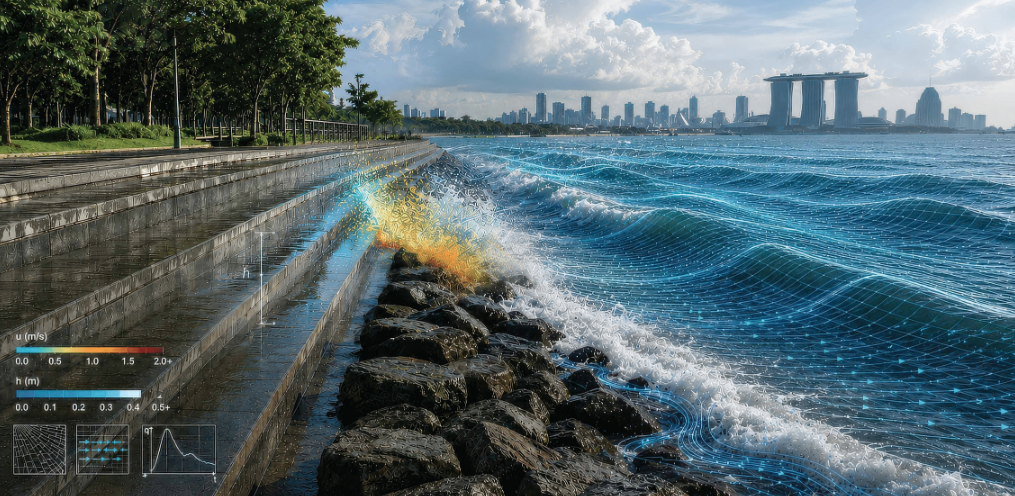
Experimental and Numerical Study on Wave Overtopping Limits and Structural Damage
When waves wash over Singapore's coastal defences, how much is too much — and how do we know when a structure is at risk? This project develops Singapore-specific guidelines for wave overtopping, combining laboratory experiments, large-scale physical testing, and advanced computer simulations. By understanding how different coastal structures respond to local wave conditions, the research will help engineers and planners design safer, more cost-effective coastal defences calibrated to Singapore's environment.
Research Goals
- Establish locally calibrated thresholds for wave overtopping discharge, flow velocity, and depth across different coastal protection structure types found in Singapore.
- Map human safety and structural stability limits under Singapore's characteristic mild wave conditions, which differ significantly from the European standards currently referenced in design guidelines.
- Develop EurOtop-compatible local modifiers and probabilistic fragility curves.
Why This Matters
- Singapore's coastal infrastructure is currently designed using international guidelines (such as the EurOtop Manual) derived from higher-energy wave climates in Europe.
- When waves overtop a coastal structure, the flow on the landward side can erode embankments, destabilise structural elements, and pose hazards to people nearby. Understanding exactly when and how this damage occurs is essential for setting the right protection levels.
- The findings will engineers a locally grounded, evidence-based toolkit for designing resilient coastal defences.
- By reducing over-engineering, the research supports more economically sustainable coastal infrastructure, freeing up resources for broader climate adaptation efforts.
Latest Research Highlights
Experimental Investigation of Wave Overtopping
- Physical model tests are underway, using scaled models of coastal protection structures representative of Singapore's coastline, including grass-covered revetments, rock revetments, and vertical seawalls.
Large-Scale 3D Physical Testing
- To validate findings beyond what 2D flume tests can capture, near-prototype-scale experiments are probing three-dimensional overtopping behaviour and lateral flow distribution across structure crests, filling a key gap that influences real-world hazard assessments.
Full-Scale CFD Simulations
Advanced Computational Fluid Dynamics (CFD) models, validated against laboratory data, are being used to simulate wave overtopping under extreme conditions and scenarios that are impractical to replicate physically.
Meet the Team
Meet the team behind the Experimental and Numerical Study on Wave Overtopping Limits and Structural Damage project.

Principal Investigator (PI):
Assistant Professor Lei Jiarui (Gary)
National University of Singapore

Co-Principal Investigator (Co-PI):
Assistant Professor Li Yuzhu (Pearl)
National University of Singapore

Co-Principal Investigator (Co-PI):
Associate Professor Qian Xudong
National University of Singapore
More Projects from the V1 Domain
Explore research under Innovative Engineering Solutions that develops adaptive, multi-functional coastal defences to enhance Singapore’s resilience to flooding, sea-level rise, and extreme weather, while optimising land use and integrating with existing infrastructure.

Download CFI's project booklet for more information on each project
CFI Singapore Tranche 1 and 2
If you wish to reach out regarding a specific project, please email CFI Singapore at cfisg@nus.edu.sg