

Understanding Monsoon-Driven Sediment Dynamics and Source-to-Sink Relationships for Coastal Management
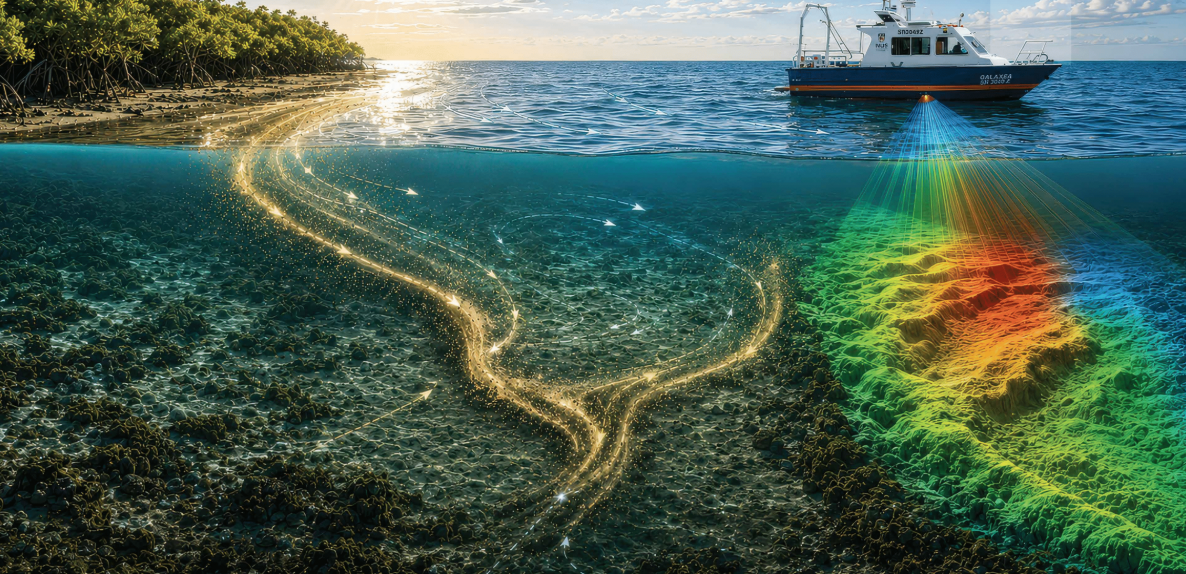
This project sets out to answer how sediments move through these waters: where they come from, how much accumulates or erodes with each season, and where they ultimately end up. Through field surveys, seabed sampling, and advanced geochemical analysis, it will build knowledge that is essential for planning effective, lasting coastal protection.
Research Goals
- Measure how environmental conditions drive changes in the seabed across Singapore's coastline
- Understand how much sediment is gained or lost along the coasts during monsoon seasons.
- Trace where sediments come from and where they go, using advanced techniques and analysis.
Why This Matters
-
About 30% of Singapore's coastline, consists of natural or partially engineered shores where nature-based and hybrid coastal protection solutions are being explored. The effectiveness of these solutions depends directly on understanding how sediments behave in these waters.
-
Sediments are the building blocks of coastal wetlands, mangroves, and sandy shores. If the sediment supply is disrupted, these ecosystems and the coastlines they protect can erode or disappear.
-
Singapore currently lacks a field-based, systems-level understanding of sediment source-to-sink relationships in the Johor Strait. This project will fill that gap, providing data that coastal planners, modellers, and policymakers can use to make better-informed decisions.
-
With climate projections pointing to more intense monsoons, stronger storms, and accelerating sea-level rise, establishing a reliable baseline of sediment behaviour now is critical for anticipating, and managing future coastal change.
Latest Research Highlights
Preliminary bathymetric surveys have already captured striking differences between monsoon and inter-monsoon periods — with significant change occurring during the Northeast Monsoon, likely driven by stronger river outflow from more northern sources.
Early measurements from the eastern Johor Strait have revealed a stratified, bi-layered water column. Stronger currents drive sediment resuspension and movement along the seabed, highlighting the importance of capturing these depth-differentiated dynamics in the study.
X-ray fluorescence (XRF) analysis of seabed sediments has revealed unexpected seasonal shifts in elemental composition suggesting that different sediment sources come into play during monsoon and inter-monsoon periods. These findings are informing the team's approach to tracing where Singapore's coastal sediments originate.
Meet the Team
Meet the team behind the Understanding Monsoon-Driven Sediment Dynamics and Source-to-Sink Relationships for Coastal Management project.

Principal Investigator (PI):
Research Assistant Professor Stephen Chua
Earth Observatory of Singapore, Nanyang Technological University
Co-Principal Investigator (Co-PI):
Professor Adam Switzer
Earth Observatory of Singapore, Nanyang Technological University
Co-Principal Investigator (Co-PI):
Associate Professor Wang Xianfeng
Earth Observatory of Singapore, Nanyang Technological University
Co-Principal Investigator (Co-PI):
Associate Professor Edward Park
National Institute of Education, Nanyang Technological University

Co-Principal Investigator (Co-PI):
Assistant Professor Li Yuzhu (Pearl)
National University of Singapore
More Projects from the H1 Domain
Explore other ongoing research initiatives under the Coastal Protection and Flood Resilience Institute (CFI) that advance Singapore’s resilience to sea-level rise, extreme weather, and coastal flooding.



Download CFI's project booklet for more information on each project
CFI Singapore Tranche 1 and 2
If you wish to reach out regarding a specific project, please email CFI Singapore at cfisg@nus.edu.sg