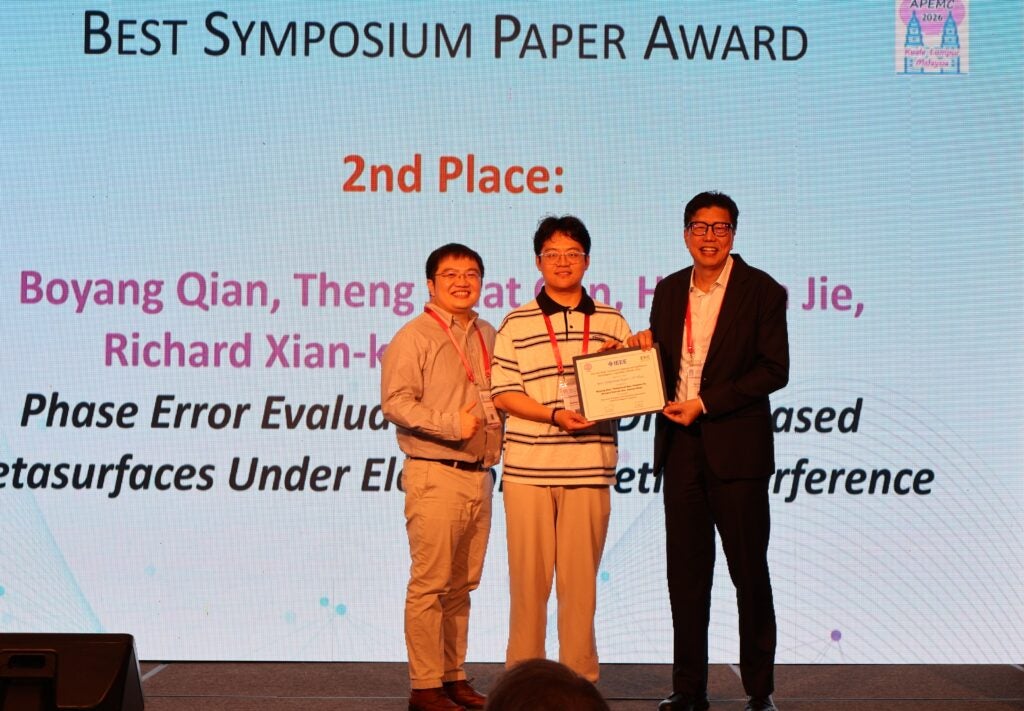

The award-winning research was recognised by an international award committee comprising leading experts in the field of Electromagnetic Compatibility (EMC). The paper, titled “Phase Error Evaluation of Pin-Diode-Based Metasurfaces Under Electromagnetic Interference,” was authored by Boyang Qian, Theng Huat Gan, Huamin Jie, Richard Xian-ke Gao, and Zhenyu Zhao, with Dr. Zhao serving as the corresponding author.
APEMC is one of the three most established international conferences in the field of EMC and the leading EMC conference in the Asia-Pacific region. Marking its 20th edition this year, the conference accepted approximately 230 papers from over 20 countries and regions, with only three papers receiving the symposium’s top paper awards.
This awarded work focuses on active metasurfaces, advanced electromagnetic structures capable of dynamically controlling wave propagation for applications such as wireless communications, sensing, radar systems, and intelligent electromagnetic technologies. Despite their potential, deploying active metasurfaces reliably in complex electromagnetic environments remains a major challenge, particularly under strong intentional or unintentional electromagnetic interference.
This work represents the first systematic study investigating the EMC performance of active metasurfaces under strong electromagnetic interference. The team developed a quantitative evaluation framework linking interference intensity, control-signal disturbance, and phase distortion, providing important insights into the operational reliability and limitations of reconfigurable metasurfaces in real-world environments.
Building on these findings, Dr Zhao and his collaborators are continuing to develop next-generation metasurface technologies designed to operate more robustly in harsh electromagnetic conditions.
This achievement highlights the growing impact of NUS ECE research in advancing resilient and intelligent electromagnetic systems for future technologies.